

What Toilet Seat Manufacturers Do and Why It Matters
When you think about a toilet seat, you probably picture a simple plastic lid. The reality? Behind every seat in every bathroom sits a surprisingly sophisticated manufacturing industry — one that blends material science, precision engineering, and global logistics into a product most people take for granted.
Toilet seat manufacturers are specialized producers that design, engineer, and fabricate toilet seats and lids from raw materials such as plastics, wood, and composites, managing the full production cycle from mold design and material processing through hinge assembly, surface finishing, quality testing, and packaging for residential and commercial markets.
The North American toilet seat market alone is valued at roughly USD 1.0 billion in 2025 and is projected to reach USD 1.7 billion by 2035. Those numbers hint at something important: this is not a niche corner of the building products world. It is a dynamic, innovation-driven industry with real consequences for every bathroom project you touch.
What Toilet Seat Manufacturers Actually Do
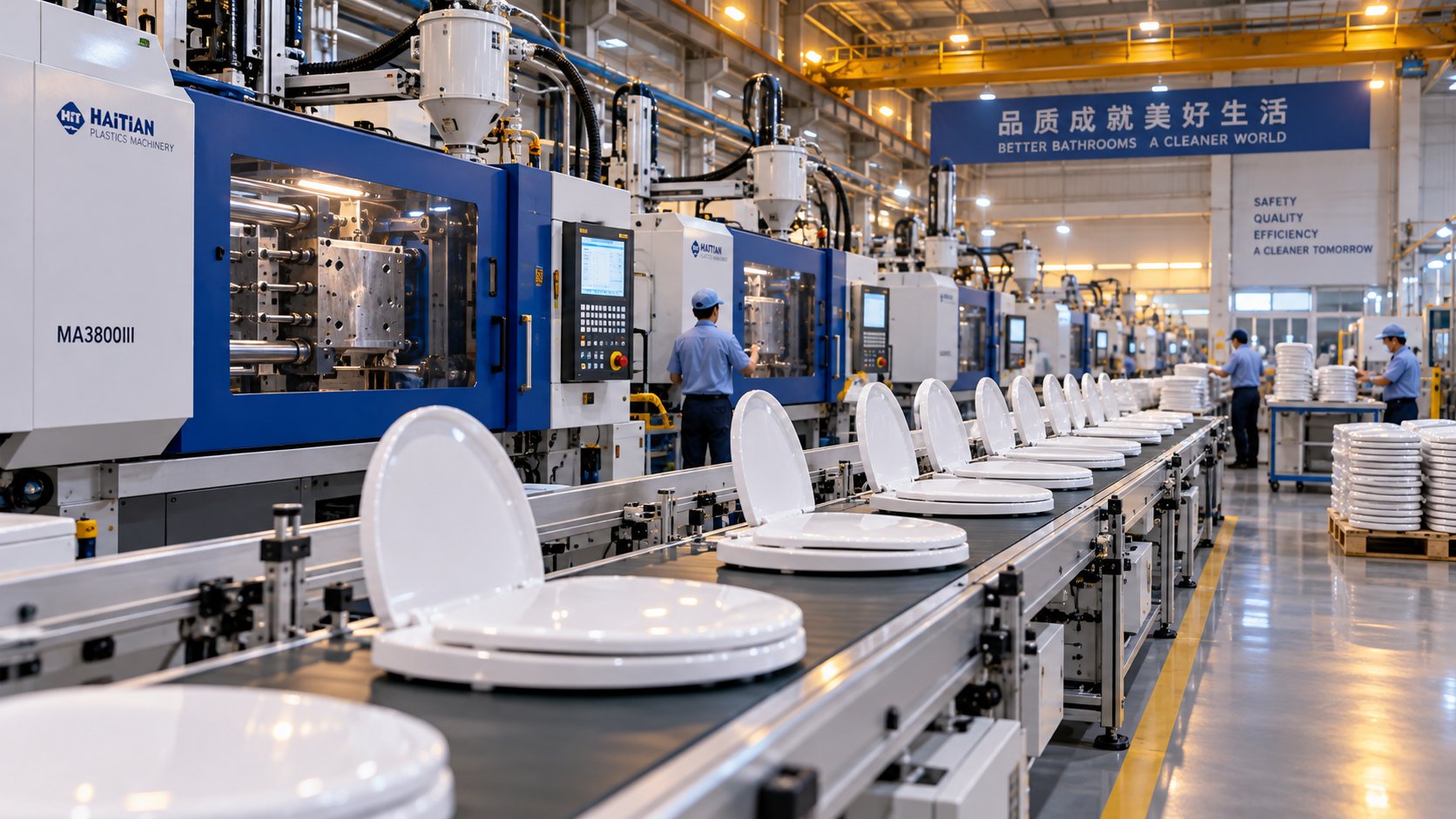
Imagine walking through a modern production facility. You will not find a single department stamping out identical lids. Instead, you'll notice separate teams focused on distinct disciplines — mold engineering for dimensional accuracy, hinge design for soft-close or quick-release functionality, surface finishing for scratch resistance and colorfastness, and rigorous quality testing that checks load-bearing capacity and cycle durability. Packaging teams then prepare products for distribution across retail, wholesale, and e-commerce channels. In short, these producers manage an end-to-end process that rivals many other precision consumer goods industries.
Why This Industry Matters to Every Bathroom Project
Whether you are a homeowner replacing a worn-out seat, a contractor specifying fixtures for a commercial build, or a procurement manager sourcing thousands of units for a hotel chain, the manufacturer behind your toilet seat directly shapes your experience. The material they choose determines scratch resistance and hygiene. The hinge mechanism they engineer dictates how quietly and reliably the lid operates over years of use. Their quality control standards influence whether that seat holds up under heavy daily traffic or cracks within months. And their business model — whether they sell under their own brand, produce for other labels, or build to your exact design — affects your cost, lead time, and customization options.
Those business models, it turns out, vary far more than most buyers realize — and understanding the differences is the first step toward smarter sourcing.
Types of Toilet Seat Manufacturers Every Buyer Should Know
Not all toilet seat manufacturers operate the same way. Some build products entirely to your specifications. Others design everything in-house and sell under their own well-known brand. A few do both — and some quietly produce the seats you see on retail shelves under names you would never associate with the actual factory that made them.
For procurement professionals sourcing thousands of units or homeowners simply trying to understand why two nearly identical-looking seats carry wildly different price tags, grasping these distinctions is essential. The business model behind a manufacturer shapes everything from pricing flexibility and lead times to customization depth and minimum order requirements.
Four primary models dominate the industry: OEM, ODM, branded, and private-label. Here is how they compare at a glance.
| Business Model | Who Designs the Product | Who Owns the Brand | Best For | Typical Minimum Order |
|---|---|---|---|---|
| OEM (Original Equipment Manufacturer) | The buyer provides specifications or designs | The buyer | Established brands and large-volume buyers seeking custom products | Higher — manufacturer must recover tooling and setup costs |
| ODM (Original Design Manufacturer) | The manufacturer designs the product | The buyer rebrands it | Importers, startups, and private-label brands wanting fast market entry | Lower — existing molds and production processes reduce setup investment |
| Branded Manufacturer | The manufacturer | The manufacturer | Homeowners and contractors who want a recognized name with proven quality | Standard retail quantities (single units to bulk) |
| Private-Label Supplier | The supplier (sometimes with buyer input) | The retailer or distributor | Retailers and distributors building their own product lines | Moderate — varies by supplier agreement |
OEM and ODM Manufacturers Explained
These two acronyms appear constantly in B2B sourcing conversations, yet many buyers conflate them. The difference matters more than you might expect.
An OEM (Original Equipment Manufacturer) builds toilet seats to a client's exact specifications. You bring the design — the shape, material, hinge type, color, branding, and packaging requirements — and the factory produces it. This model offers the highest level of customization and product differentiation. A bathroom brand developing a signature heated toilet seat line with proprietary hinge geometry, for example, would typically work with an OEM partner. The trade-off? Higher upfront investment. OEM projects often require new mold development, prototype production, performance testing, and sample revisions before mass production begins — all of which extend lead times and raise minimum order quantities.
An ODM (Original Design Manufacturer), by contrast, already has the product designed, engineered, and production-ready. You select from existing models, apply your branding, and potentially customize secondary elements like packaging, logo placement, or accessory selection. Think of ODM as a "ready-to-brand" approach. It dramatically cuts development time — sourcing through an ODM can reduce timelines by 30 to 50 percent compared to a full OEM project. For companies testing a new market or launching a bidet WC seat category without heavy R&D spending, ODM provides a lower-risk entry point.
Here is a practical way to think about it: OEM is "build what I designed," while ODM is "let me brand what you have already built." Many growing businesses actually start with ODM to validate demand, then graduate to OEM once order volumes justify the tooling investment.
Branded Manufacturers vs Private-Label Suppliers
Walk into any home improvement store and you will spot familiar names on toilet seat packaging — Bemis, for instance, is one of the most recognized branded manufacturers in North America. A branded manufacturer designs, produces, and sells products under its own name. It controls the entire value chain, from material sourcing and engineering through marketing and warranty support. When you buy a Bemis seat, you are buying directly from the company that conceived, built, and stands behind that product.
This model gives consumers a clear quality signal. Branded manufacturers stake their reputation on every unit, which typically means rigorous internal quality control, consistent material standards, and accessible customer service. For homeowners, that translates to confidence at the point of purchase. For contractors, it means reliable spec sheets and predictable performance across projects.
Private-label suppliers operate in the background. They produce toilet seats that retailers, distributors, or e-commerce sellers package and sell under their own store brand or house label. The seat on the shelf might carry a retailer's logo, but it rolled off the production line at a factory that also makes seats for several other brands. Private-label arrangements give retailers greater margin control and branding flexibility, while the supplier benefits from consistent volume.
For B2B buyers, the key takeaway is this: the brand printed on the box does not always tell you who actually manufactured the seat. Understanding whether you are dealing with a branded manufacturer, a private-label supplier, an OEM partner, or an ODM factory changes how you negotiate pricing, assess quality, and plan your supply chain.
Of course, regardless of business model, every one of these producers must choose raw materials — and that choice shapes everything from the seat's weight and scratch resistance to its price tag and lifespan.
Toilet Seat Materials Compared From Plastic to Wood
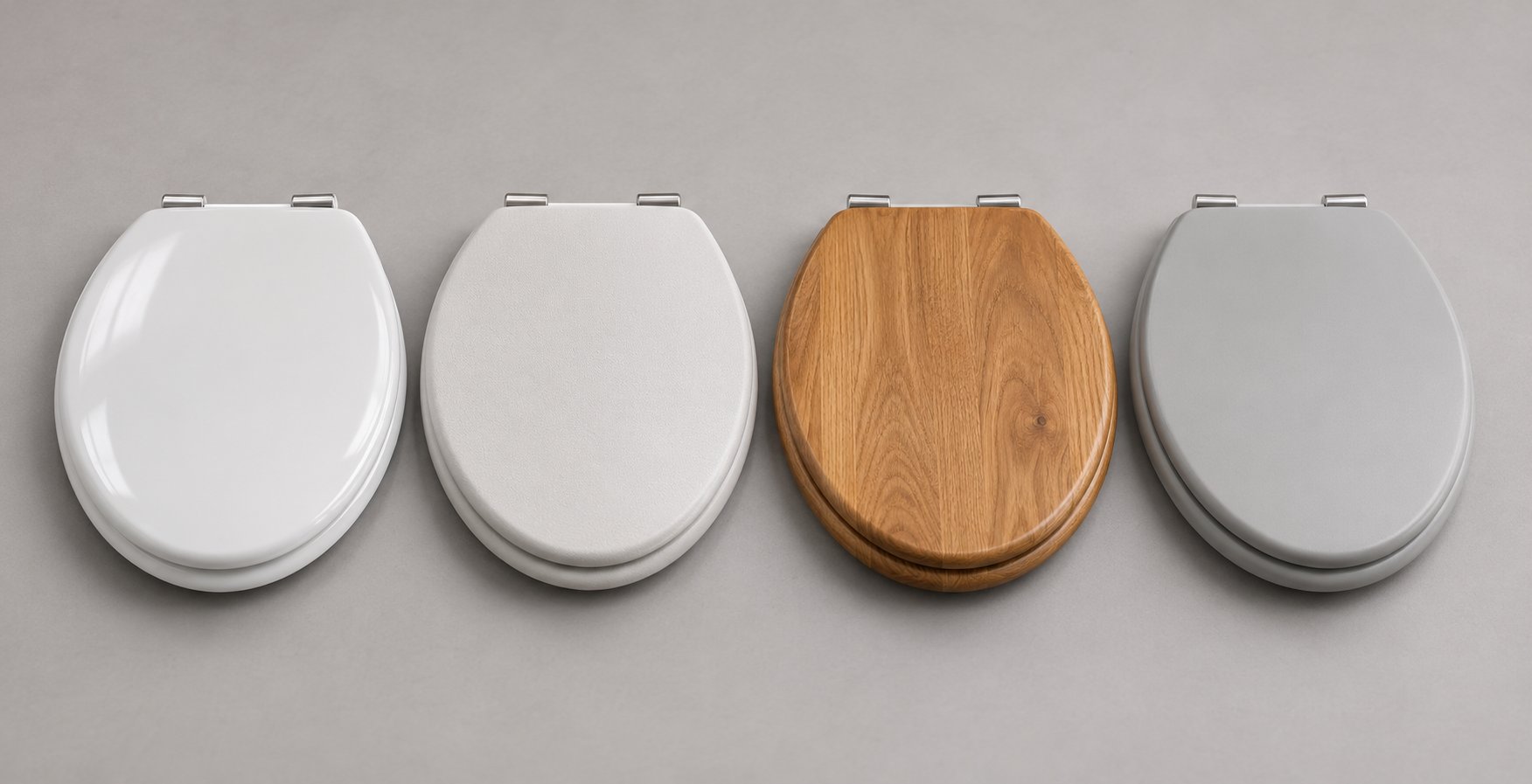
Material selection is where every toilet seat manufacturer makes its most consequential decision. The substance a seat is molded or shaped from determines how it feels when you sit down, how it looks after three years of daily use, how easily it resists scratches and cleaning chemicals, and — ultimately — how much it costs. Yet most buyers, whether sourcing a single round toilet seat for a guest bathroom or specifying hundreds of units for a hospitality project, have never seen these materials laid out side by side in a practical format.
The table below changes that. It covers the six material families you will encounter most often when evaluating products from toilet seat manufacturers worldwide.
| Material | Durability | Weight | Scratch Resistance | Cost Range | Ideal Application |
|---|---|---|---|---|---|
| Polypropylene (PP) | Moderate — may degrade noticeably within 2-3 years under heavy use | Light | Low to Moderate | Low | Rental properties, guest bathrooms, budget-friendly replacements |
| Urea-Formaldehyde (UF / Duroplast) | High — retains shape and color for many years | Heavy | High | Medium to High | Family bathrooms, premium residential, high-traffic commercial |
| Thermoplast (General) | Moderate | Light to Medium | Moderate | Low to Medium | Mid-range residential, standard replacements |
| Solid Wood (Moulded Wood) | High when properly finished | Heavy | Moderate — depends on lacquer quality | High | Luxury bathrooms, period properties, design-forward interiors |
| MDF with Coating | Moderate — vulnerable if finish chips | Medium to Heavy | Moderate | Medium | Traditional and rustic bathroom styles |
| Composite Materials | Moderate to High — varies by formulation | Medium | Moderate to High | Medium | Custom applications, blended performance requirements |
Sounds simple enough in a grid — but the real story emerges when you dig into how each material behaves in practice.
Polypropylene and Urea-Formaldehyde Seats Compared
These two materials represent the backbone of the global toilet seat industry, and understanding their differences is essential whether you are a homeowner picking a replacement or a brand manager developing a product line.
Polypropylene (PP) is a semi-crystalline thermoplastic — lightweight, chemically resistant, and inexpensive to manufacture. Its smooth, flat surface and uniform thickness make it one of the most widely used seat materials on the planet. PP seats are moisture-resistant, non-toxic, and easy to produce in a wide range of colors. That versatility is exactly why you will find them dominating the budget and mid-range shelves. Prices typically fall between $15 and $40 USD at the retail level.
The trade-offs? PP's softer surface is more prone to scratching over time. It can flex slightly under load, sometimes causing a faint creak that signals cheaper construction. White PP seats, in particular, tend to yellow or discolor with age — a common frustration for homeowners who notice their once-bright seat looking dingy after a couple of years. This aging characteristic also limits PP's colorfastness, making it less suitable for applications where appearance must remain consistent over long service life.
Urea-formaldehyde (UF), frequently marketed as duroplast, occupies a different tier entirely. UF is a thermosetting plastic — once molded under high temperature and pressure, it cannot be remelted or reshaped. This irreversible curing process gives the finished seat exceptional hardness, dimensional stability, and a dense, ceramic-like feel that PP simply cannot replicate. Pick up a duroplast seat and you will immediately notice the difference: it is heavier, more rigid, and produces a solid, reassuring sound when you tap it.
Scratch resistance is where UF truly separates itself. The hard surface shrugs off contact that would leave visible marks on a polypropylene seat, and it holds up well against household disinfectants and cleaning agents. UF seats also retain their shape and color over many years, making them the preferred choice for premium residential bathrooms and high-use commercial settings. Retail pricing generally ranges from $20 to $70 USD, reflecting the more demanding manufacturing process.
From a hinge compatibility perspective, UF's rigidity allows it to support robust soft-close and quick-release hinge systems without the flex-induced stress that can wear down hinge pivot points on lighter PP seats. For long-term hygiene, the non-porous UF surface resists stain penetration more effectively, which translates to easier cleaning and a more sanitary seat over its lifespan.
For sanitary ware manufacturers and bathroom brands evaluating PP versus UF for their own seat and lid assemblies, resources like Tianyun's PP and UF Toilet Seat Cover Collection can support the material selection process, offering OEM customization and soft-close hinge matching alongside both material options.
Wood and Composite Toilet Seat Materials
Imagine stepping into a bathroom styled with warm wood tones, brass fixtures, and traditional tilework. A plastic seat — no matter how well-made — would feel visually out of place. This is where solid wood and MDF seats earn their role.
Solid wood (moulded wood) seats are crafted from real timber that has been shaped, sanded, and finished with lacquer or paint. Each seat carries unique grain patterns, delivering a genuinely premium, handcrafted feel. The thermal comfort advantage is real, too — wood never feels cold to the touch the way plastic or ceramic surfaces do, a small but meaningful comfort factor in cooler climates. Well-finished solid wood seats are surprisingly durable and can serve for years in a well-ventilated bathroom.
The honest reality, though, is that wood demands more care. Prolonged moisture exposure can compromise even high-quality lacquer finishes, leading to swelling or cracking over time. These seats are the most expensive option in the material lineup, and they are best suited to en-suites, low-traffic powder rooms, or luxury residential settings where aesthetics justify the investment and the homeowner is willing to maintain the finish.
MDF (Medium-Density Fibreboard) seats offer a middle path. Made from compressed wood fibers bonded with resin and coated with lacquer, veneer, or foil wrap, they capture much of the warmth and natural appearance of real wood at a lower price point. MDF seats work beautifully in traditional, rustic, and Scandinavian-style bathrooms. They can even be fitted with soft-close and quick-release hinges, matching the convenience features buyers expect today.
The vulnerability to watch for is moisture infiltration. If the protective coating gets chipped, scratched, or worn — perhaps because a clogged toilet situation required aggressive cleaning around the seat — moisture can penetrate the compressed fibers underneath, causing swelling and delamination. For high-humidity bathrooms without good ventilation, MDF may not be the wisest long-term choice.
Composite materials round out the landscape. These engineered blends — combining resins, fillers, and sometimes recycled content — allow manufacturers to fine-tune weight, strength, and surface characteristics for specific applications. Composites are increasingly popular among producers looking to balance performance with cost in custom product lines.
Knowing what a seat is made of is only half the picture, though. The way that raw material gets transformed — heated, pressured, molded, finished, and assembled with precision hinge hardware — is where manufacturing expertise either makes or breaks the final product.
How Toilet Seats Are Manufactured Step by Step
A bag of plastic pellets sitting on a factory floor looks nothing like the polished, precision-fitted seat that ends up in your bathroom. The transformation between those two states involves carefully controlled heating, pressure, cooling, finishing, and assembly — each step calibrated to the specific material being used. Here is what that journey actually looks like inside a modern production facility.
- Raw material drying — removing absorbed moisture from plastic pellets before molding
- Molding — shaping the seat and lid through injection or compression molding
- Cooling and demolding — stabilizing dimensions and ejecting the part from the mold
- Post-processing — trimming, deburring, polishing, and applying surface coatings
- Hinge assembly — matching and installing the appropriate hinge system
- Quality control and testing — verifying structural integrity, dimensions, and functional performance
- Packaging — preparing the finished seat for distribution
Every stage matters, but the two that most dramatically shape the final product are the molding process and the hinge assembly.
From Raw Pellets to Molded Seats
The production method hinges on one fundamental question: is the material a thermoplastic or a thermoset?
Injection molding is the standard process for thermoplastic seats made from polypropylene (PP) and similar materials. Picture this: dried plastic pellets are fed into a heated barrel, melted to a precise temperature — typically 195 to 215 degrees Celsius for PP — and then injected under high pressure into a closed steel mold. The molten plastic fills every contour of the mold cavity, cools, and solidifies into the exact shape of the seat or lid. Cycle times for a typical toilet seat run roughly 55 to 70 seconds, depending on wall thickness and mold configuration. Injection molding excels at producing complex, high-precision components with excellent repeatability — which is exactly what you need when manufacturing thousands of dimensionally consistent seats.
Before molding even begins, though, raw pellets must be thoroughly dried. PP requires drying at 60 to 80 degrees Celsius for one to two hours. Higher-performance materials like PC/ABS blends demand more aggressive drying — up to 120 degrees Celsius for eight to ten hours. Skip this step or cut it short, and moisture trapped inside the pellets turns to steam during injection, producing bubbles, silver streaks, and weakened structural integrity. For a load-bearing product like a toilet seat, that kind of defect is not cosmetic — it is a potential safety issue.
Compression molding takes a fundamentally different approach and is the method used for urea-formaldehyde (UF/duroplast) seats. Instead of melting and injecting the material, a pre-measured charge is placed directly into a heated mold cavity. The mold closes under tremendous pressure, forcing the material to flow and fill the cavity while a chemical curing reaction permanently hardens it. Unlike thermoplastics, thermoset materials undergo an irreversible change — once cured, they cannot be remelted. This process yields seats with superior strength and density, producing that heavy, ceramic-like feel buyers associate with premium quality. The trade-off is a slower cycle time and somewhat less flexibility for intricate geometries compared to injection molding.
After demolding, both types of seats move through post-processing. Edges are trimmed and deburred to eliminate any flash or rough spots left from the molding process. Surfaces may be polished for a smooth, glossy finish, treated with UV-resistant or protective coatings, or even painted to match specific color requirements. For large, flat parts like toilet seats, even demolding demands care — ejector force must be distributed evenly across the part to prevent warping or deformation.
Hinge Assembly and Quality Control
Here is something most people never consider: the hinge system often determines whether a toilet seat feels cheap or premium. You could mold a flawless UF seat with a perfect surface finish, and a poorly matched hinge would undermine the entire product experience.
Three primary hinge types dominate the market. Soft-close hinges use internal damping mechanisms — typically hydraulic or controlled-friction dampers — to slow the seat and lid as they approach the bowl, eliminating the slam that wakes up the household at midnight. Quick-release hinges allow the entire seat to be detached from the bowl with a simple button press or lever action, making cleaning dramatically easier. Standard friction hinges provide basic open-and-close functionality at the lowest cost point.
Matching the right hinge to the right seat is more nuanced than it sounds. As sourcing specialists note, a damper calibrated for a lightweight PP seat may perform inconsistently on a heavier duroplast lid — closing too slowly, sticking, or failing to reach full closure. Conversely, a hinge designed for a heavy seat can feel sluggish on a lighter product. The factory must confirm that the selected hinge was developed or approved for the exact seat-and-lid configuration being produced.
Hinge bases typically use stainless steel or zinc alloy to resist the corrosive humidity of bathroom environments. During assembly, technicians perform torque calibration and damping tests to verify consistent left-right closing behavior. Dimensional precision of the hinge mounting holes — set during the molding stage — is critical here. Even slight deviations can cause assembly difficulties, sticking, or annoying noises during daily use.
Quality control checkpoints are woven throughout the entire production sequence, not just tacked on at the end. Typical benchmarks include load-bearing tests of 150 to 200 kilograms to verify structural strength, soft-close cycle tests ranging from 30,000 to 50,000 cycles to confirm damper longevity, chemical resistance testing against common household cleaning agents, colorimeter checks for finish consistency, and dimensional verification to ensure every seat fits its intended bowl. Surface inspections catch cosmetic defects — scratches, discoloration, uneven coatings — before they reach the customer.
The rigor of these controls varies significantly between manufacturers. A producer focused on residential seats may emphasize aesthetics and soft-close smoothness, while one serving commercial or institutional markets faces an entirely different set of durability and compliance demands — a distinction that reshapes product design from the ground up.
Residential vs Commercial Toilet Seat Production Differences
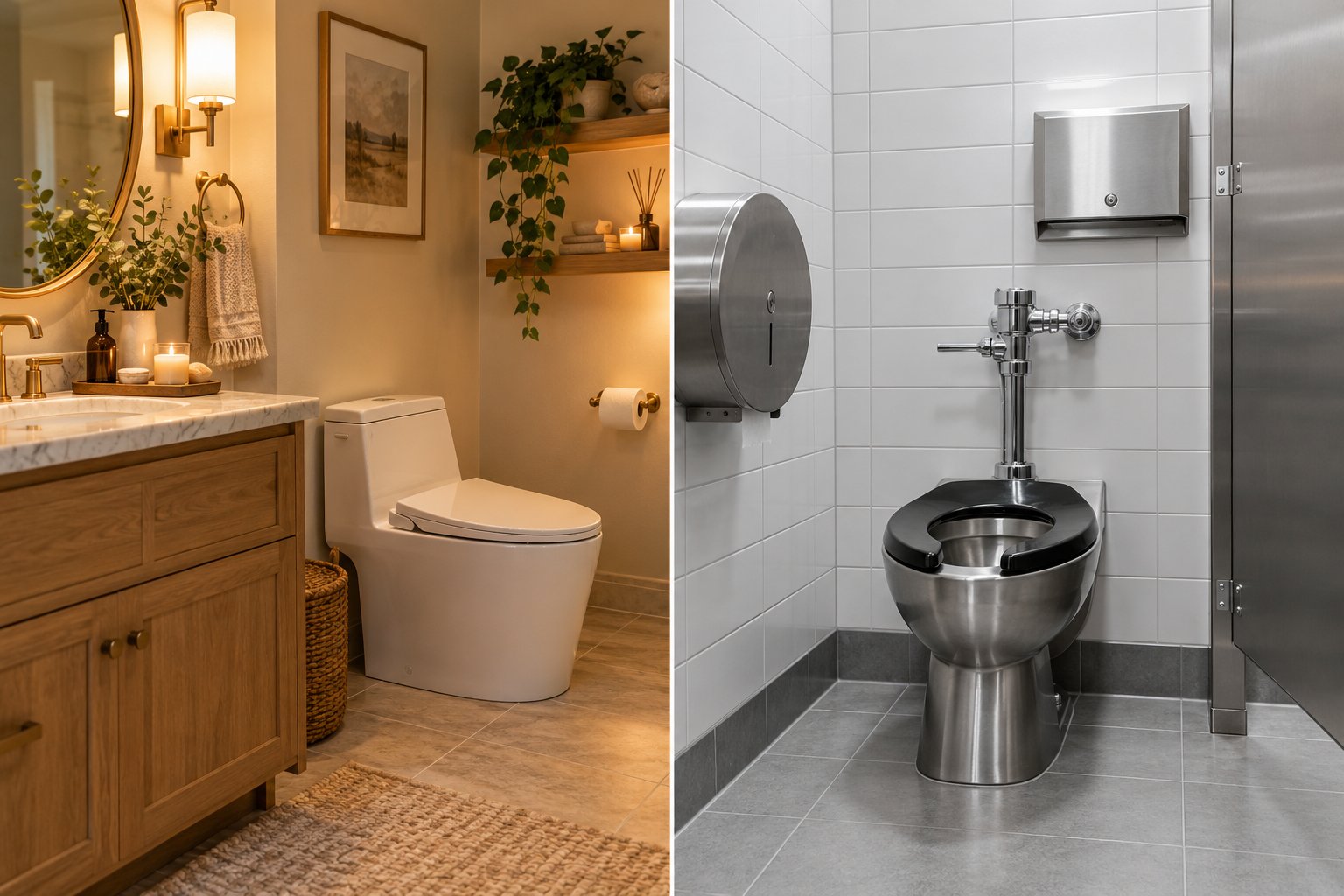
A toilet seat designed for a master bathroom renovation and one specified for a busy airport restroom might look similar at first glance — but the engineering priorities behind them diverge sharply. The same manufacturer may produce both, yet the design briefs, material selections, hinge specifications, and testing protocols for each segment operate in almost entirely separate universes. If you are a contractor specifying toilet seats for a commercial build or a procurement manager sourcing institutional-grade products, understanding these differences is not optional — it is the difference between a seat that lasts and one that fails within months.
| Dimension | Residential | Commercial / Institutional |
|---|---|---|
| Typical Materials | PP, UF/duroplast, wood, MDF | UF/duroplast, heavy-duty PP, reinforced composites |
| Hinge Type | Soft-close, quick-release, standard friction | Heavy-duty stainless steel, self-sustaining, vandal-resistant |
| Shape Requirements | Round and elongated, color-matched to bowl | Elongated open-front (mandated by many building codes) |
| Durability Standard | Moderate — rated for household frequency | High — rated for continuous high-traffic use |
| Replacement Cycle | Every 5-8 years (typical homeowner timeline) | Every 1-3 years depending on traffic volume |
| Primary Buyer | Homeowners, residential contractors, interior designers | Facility managers, commercial contractors, hospitality procurement |
Residential Toilet Seat Manufacturing Standards
Picture yourself browsing toilet seats at a home improvement store. What catches your eye first? Color. Shape. Whether it has a soft-close lid. That reaction perfectly reflects what residential manufacturing prioritizes — aesthetics, comfort, and design compatibility.
Homeowners want their toilet seats to complement the bathroom's overall look. That means producers must offer extensive variety: round and elongated shapes, a wide palette of whites and colors, matte and gloss finishes, and even specialty designs for themed or luxury interiors. Comfort features drive purchasing decisions at this level. Soft-close dampers that prevent the midnight slam, heated surfaces for cold-climate bathrooms, and quick-release mechanisms that make cleaning easier have all shifted from premium extras to near-standard expectations in the residential segment.
Ease of installation matters enormously here, too. Most homeowners replace toilet seats themselves — so residential manufacturers design mounting hardware that works with common household tools and fits universally across standard bowl sizes. Replacement availability is another quiet priority. When a commode gets stopped up and aggressive plunging chips the seat, or years of use finally take their toll, homeowners expect to find a matching replacement quickly. Producers serving this segment maintain broad distribution through retail and e-commerce channels precisely for that reason.
Commercial and Institutional Seat Requirements
Step into a hospital, school, or airport restroom and the priorities flip dramatically. Aesthetics still matter, but durability, hygiene, and regulatory compliance dominate every specification sheet.
Many building codes require open-front (horseshoe-shaped) seats in public and commercial restrooms. This design eliminates the front contact area, reducing the risk of contact with genital areas and improving hygiene in shared facilities. It is not a stylistic choice — it is a code-mandated requirement in many jurisdictions.
Hinges in commercial settings must handle vastly higher use frequencies. Where a residential soft-close mechanism might see a few dozen cycles per day, a commercial hinge in a busy facility endures hundreds. Heavy-duty seats designed for institutional use typically support 500 to 1,200 pounds — far exceeding the 250-to-300-pound range of standard residential models — using reinforced mounting hardware, oversized non-slip bumpers, and metal or high-strength composite hinges that resist loosening under repeated stress. ADA-compliant considerations add another layer: seats for accessible stalls may need specific heights, stable weight distribution, and compatibility with grab-bar configurations.
Material choices shift accordingly. You will rarely see MDF or solid wood in a commercial restroom. Instead, heavy-duty duroplast and reinforced polypropylene dominate because they resist scratching, chemical cleaners, and the inevitable rough handling of public environments. Commercial buyers also evaluate stain resistance more aggressively — these seats must survive daily cleaning with industrial-strength disinfectants without yellowing or surface degradation.
Some toilet seat manufacturers operate dedicated product lines for each segment, applying their core molding and assembly expertise across both residential and commercial ranges. Others specialize exclusively in one arena, investing deeply in the specific certifications and testing protocols that market demands. For contractors and facility managers, the critical question during sourcing is straightforward: was this seat engineered for the traffic volume and regulatory environment it will actually face?
That question becomes even more complex as the industry's innovation frontier expands — with smart technology, bidet integration, and antimicrobial surfaces reshaping what a toilet seat can do far beyond simply supporting a person's weight.
Smart Seats and Emerging Trends in Toilet Seat Manufacturing
A toilet seat used to be a passive component — a lid, a hinge, and a mounting bracket. That description no longer captures where the industry is headed. Electronic bidet integration, heated surfaces, antimicrobial coatings, and sensor-driven features are transforming the humble seat into one of the most technologically dense objects in the modern bathroom. For toilet seat manufacturers, this shift demands entirely new engineering capabilities that go far beyond traditional molding and hinge assembly.
Smart Toilet Seats and Bidet Seat Manufacturing
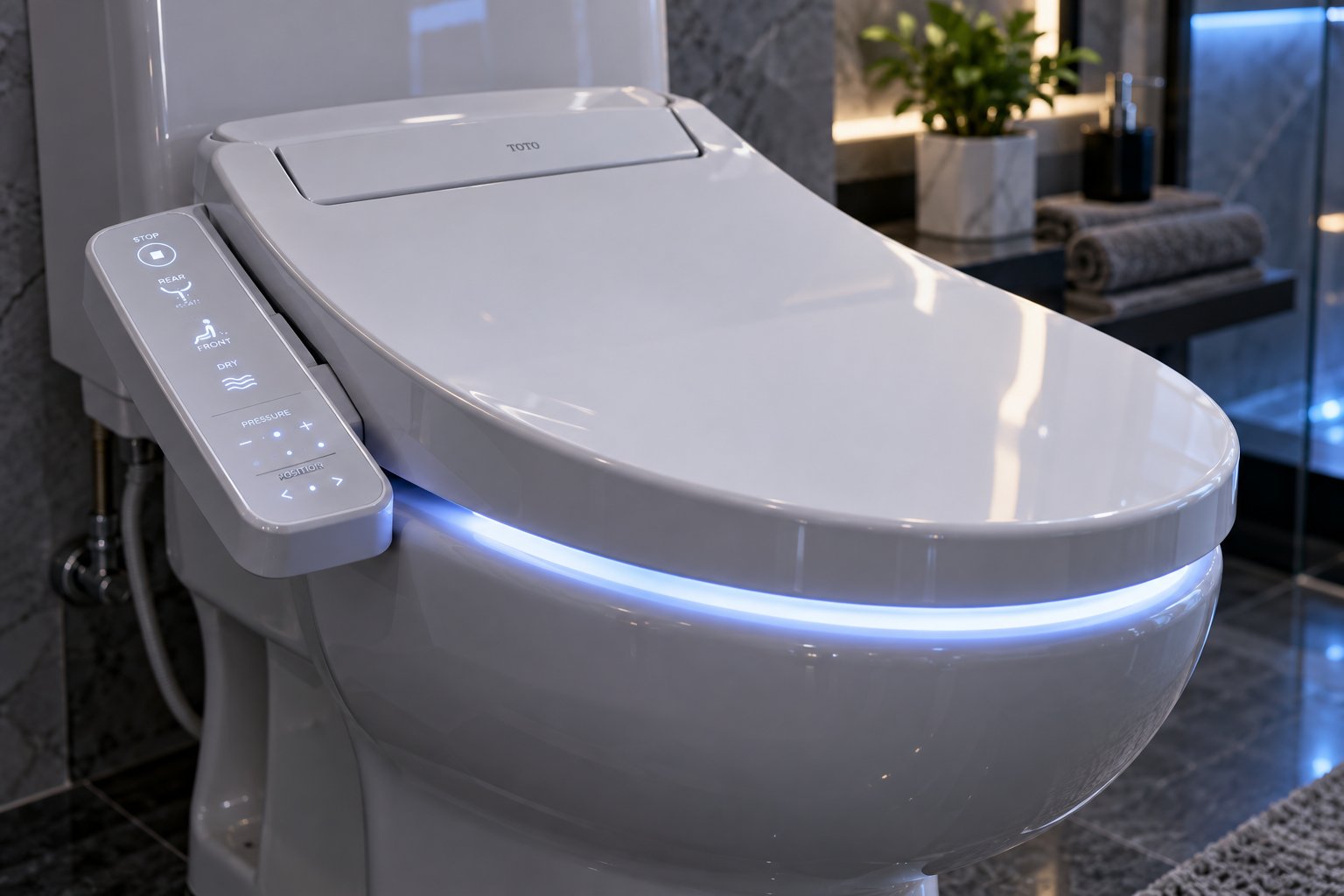
Imagine sitting down on an elongated toilet seat that automatically warms to your preferred temperature, delivers a precisely aimed wash with adjustable water pressure and temperature, dries you with warm air, deodorizes the bowl, and illuminates the floor with a soft night light — all without you touching a single control. That is the reality of today's smart and bidet-integrated seats, and manufacturing them is a fundamentally different challenge than producing a conventional plastic seat.
The complexity starts with electronics enclosure. Every smart seat must house a control board, heating elements, a water pump or pressure system, wiring harnesses, and — in premium models — sensors for occupancy detection and automatic lid operation. All of these components sit inches from a toilet bowl, meaning the enclosure must meet rigorous waterproofing standards. Manufacturers must design sealed compartments that prevent moisture intrusion while still allowing adequate heat dissipation from electronic components. Power supply routing adds another layer: the seat needs a safe, code-compliant electrical connection, typically through a grounded outlet adjacent to the toilet, which means product teams must navigate both plumbing and electrical safety certifications simultaneously.
The global bidet seat market is estimated at USD 4.59 billion in 2026 and is projected to reach USD 7.32 billion by 2033 at a 6.9% CAGR — making bidet-style seats one of the fastest-growing categories in bathroom fixtures. Premium electronic formats within the broader toilet seat market are expanding at roughly 8 to 12 percent annually, driven by rising hygiene awareness and smart-home adoption. Japan remains the technology benchmark, where electronic bidet seats are installed in more than 75% of households and manufacturers compete on water temperature control, energy efficiency, and ergonomic design rather than basic seat construction.
For established brands like Bemis and newer entrants alike, the strategic challenge is clear: smart seat production requires investment in electronic assembly lines, firmware development, waterproof testing equipment, and after-sales service infrastructure that traditional seat factories simply do not possess. Companies like TOTO, LIXIL, and Kohler have responded by expanding their smart-bathroom portfolios — TOTO introduced a modular WC element in 2026 that separates the flush frame from its motor to enable staged WASHLET upgrades, while Kohler launched the PureWash E860 dual-wand bidet seat with dedicated front-wash technology for women's hygiene.
Antimicrobial Surfaces and Soft-Close Innovation
Smart electronics are not the only frontier. Material-level innovation is quietly reshaping what the seat surface itself can do.
Antimicrobial surface treatments embed bacteria-inhibiting agents directly into the seat material or apply them as a surface coating during manufacturing. The most common approaches use inorganic antimicrobial agents — silver ions, copper compounds, and zinc-based additives — that interrupt microbial reproduction on contact. Unlike organic treatments that may degrade over time, inorganic agents resist high processing temperatures and maintain effectiveness throughout the seat's lifespan. Testing under standards like ISO 22196 can demonstrate up to a 99.9% reduction in bacterial surface persistence under controlled conditions. For healthcare facilities, hospitality operators, and hygiene-conscious homeowners, this is a meaningful differentiator — one that manufacturers are increasingly integrating into higher-margin product lines.
UV-resistant coatings serve a complementary role, protecting seat surfaces from yellowing and degradation caused by sunlight exposure and cleaning chemical reactions. Combined with antimicrobial properties, these treatments create seats that stay cleaner and look newer for significantly longer than untreated alternatives.
Soft-close damper technology has evolved considerably from its early iterations. First-generation hydraulic dampers provided a basic controlled descent — better than a slam, but sometimes inconsistent across temperature ranges or after extended use. Today's precision-engineered multi-position dampers deliver smooth, uniform closing behavior regardless of how forcefully the lid is released, and they maintain that consistency across tens of thousands of cycles. The engineering involves calibrated internal fluid viscosity, temperature-compensating seals, and corrosion-resistant housings that hold up in humid bathroom environments year after year.
Quick-release hinge systems round out the innovation picture. These mechanisms allow the entire seat and lid to detach from the bowl with a simple button press or lever action — no tools needed. The benefit is practical and immediate: thorough cleaning around the mounting area becomes a thirty-second task instead of an awkward wrestling match. Hotels and facility operators increasingly favor these systems because they can reduce seat servicing time by approximately 20 to 30 percent, improving room turnover and maintenance productivity. Residential buyers are catching on, too, as quick-release designs become available across a wider price range.
Here is a summary of the key innovation trends that forward-thinking manufacturers are actively pursuing:
- Integrated electronic bidet systems — wash, dry, deodorize, and heat functions within a single seat assembly
- Antimicrobial material additives — silver-ion, copper, and zinc-based agents embedded during molding for permanent bacterial resistance
- Precision soft-close dampers — multi-position, temperature-compensating mechanisms rated for 30,000+ cycles
- Quick-release hinge systems — tool-free seat removal for faster, more hygienic cleaning
- Occupancy and motion sensors — automatic lid opening, closing, and flush activation
- Low-energy heated surfaces — energy-efficient warming elements meeting evolving European efficiency requirements
- App-connected diagnostics — remote monitoring of water usage, energy consumption, and maintenance alerts
- Modular upgrade platforms — standardized seat chassis that accept multiple feature tiers without replacing the ceramic toilet
These innovations are not just adding features — they are redefining the manufacturing capabilities, testing infrastructure, and certification requirements that producers must meet. And those certifications, along with a growing emphasis on sustainable production practices, are becoming the trust signals that increasingly separate credible manufacturers from the rest of the field.
Certifications and Sustainability in Toilet Seat Manufacturing
A glossy product photo and an attractive price point can tell you a lot about marketing — but very little about whether a toilet seat will hold up under real-world conditions or whether the factory that produced it operates responsibly. That is where certifications and sustainability practices come in. These two areas function as trust signals, giving buyers — from procurement managers sourcing institutional-grade seats to homeowners comparing options online — a concrete way to distinguish between manufacturers who invest in verifiable quality and those who simply claim it.
Key Certifications and Testing Standards
When a toilet seat manufacturer states that its products meet recognized testing standards, what does that actually mean in practice? It means the product has been submitted to independent, third-party evaluation across multiple performance dimensions — load-bearing capacity, hinge durability, chemical resistance, surface integrity, and dimensional accuracy. The seat did not just pass an internal inspection. It survived a structured battery of tests conducted by an outside laboratory with no financial stake in the outcome.
Several standards and certification frameworks are particularly relevant, depending on the destination market:
ASTM specifications cover plastic toilet seats in the North American market. These standards define minimum performance requirements for material strength, resistance to household chemicals, and structural integrity under load. A seat certified against applicable ASTM criteria has demonstrated that it can withstand prescribed stress conditions without cracking, deforming, or degrading in ways that would compromise safety or usability.
Regional durability standards vary by market but share common testing priorities. In Europe, standards such as DIN 19516 evaluate load resistance and safety compliance, while France's NF Norm focuses on long-term stability and the UK's BS 1254:1981 targets hinge strength and mechanical performance. Asia references JCT 764-2008 for material behavior and general safety. Each framework defines its own minimum acceptable performance — but none of them guarantee that a seat will exceed those minimums under the specific conditions of your project.
ISO quality management standards — particularly ISO 9001 — evaluate the manufacturer's production systems rather than individual products. A factory holding ISO 9001 certification has demonstrated that its quality management processes meet internationally recognized benchmarks for consistency, traceability, and continuous improvement. This matters because a single product test represents a moment in time, while a well-managed quality system improves the odds that every seat coming off the line meets the same standard. That said, ISO 9001 is not a substitute for product-level certification — it confirms process discipline, not that any specific seat passed a specific performance test.
ADA compliance addresses accessible design for users with disabilities. In commercial and institutional settings, toilet seats may need to meet specific height, stability, and weight-distribution requirements to serve accessible stalls properly. ADA-compliant design is not a standalone certification in most cases but rather a set of design parameters that manufacturers must incorporate and verify during product development.
Here is the critical insight many buyers miss: testing standards provide structure and comparability, but they do not replace process discipline or material expertise. A certificate should be viewed as an entry criterion — useful and necessary, yet incomplete on its own. The real question is whether a manufacturer consistently meets or exceeds those standards across every production batch, not just the samples submitted for laboratory evaluation. Retained samples, batch traceability systems, and internal inspection records are the indicators that separate manufacturers who treat certification as a minimum from those who treat it as a ceiling.
Sustainability and Eco-Friendly Manufacturing Practices
Certifications verify what a seat can do. Sustainability practices reveal how responsibly it was made — and increasingly, buyers at every level care about both.
The toilet seat industry is not typically the first sector people associate with environmental innovation. Yet the shift toward sustainable manufacturing is real and accelerating. Some producers are rethinking every stage of the production cycle, from raw material sourcing through end-of-life recyclability.
Recycled-content materials represent one of the most tangible advances. Rather than relying exclusively on virgin plastics, forward-thinking manufacturers are incorporating post-consumer or post-industrial recycled content into their formulations. One European manufacturer reports that 61% of the raw material in its proprietary seat formulation comes from food waste, wood waste, and recycled sources — verified by SGS, a global leader in testing and certification. The resulting seats are 100% recyclable: when they reach the end of their service life, they can be reprocessed and reintroduced as material for manufacturing new seats. Even production rejects and surplus material generated during manufacturing are collected, processed, and fed back into the production line rather than sent to landfill.
Carbon footprint reduction extends beyond material composition. Vertical integration — where a single facility handles everything from raw material production to finished product assembly — minimizes the transportation emissions associated with shipping components between multiple factories. Local raw material sourcing further shrinks the logistics footprint. Some facilities have installed solar panels and adopted energy-recovery systems to reduce CO2 emissions from their manufacturing operations. In certain cases, the combination of waste-derived raw materials and localized production can result in a material with a negative carbon footprint — meaning the seat's production actually offsets more carbon than it generates.
Responsible packaging is another area of quiet progress. FSC-certified cardboard boxes, recycled cardboard protections replacing polystyrene inserts, and fixture bags made from recycled plastic are replacing conventional packaging materials. These changes are incremental, but across millions of units shipped annually, the cumulative impact is significant.
Product longevity is perhaps the most underappreciated sustainability factor. A toilet seat that resists yellowing, maintains its structural integrity, and looks new after years of daily use does not need to be replaced — and a seat that never enters the waste stream is the most environmentally friendly option of all. Durable materials like UF/duroplast and well-engineered composite formulations contribute directly to this goal by extending service life well beyond what budget materials can achieve.
If you are evaluating toilet seat manufacturers with sustainability in mind, here are the key indicators worth asking about:
- Recycled content percentage — what proportion of the raw material comes from recycled or waste-derived sources, and is this verified by a third-party certification body?
- End-of-life recyclability — can the finished seat be reprocessed into new material, or does it end up in landfill?
- Energy sourcing — does the facility use renewable energy sources such as solar, wind, or energy-recovery systems?
- Manufacturing waste management — is production surplus and scrap material recaptured and reintegrated into the production process?
- Packaging materials — are boxes, inserts, and bags made from recycled or sustainably sourced materials?
- Supply chain localization — does the manufacturer source raw materials locally to reduce transportation emissions?
- Environmental certifications — does the facility hold ISO 14001 (environmental management) or equivalent third-party environmental verification?
- Product lifespan engineering — is the seat designed and tested for long-term durability, reducing the frequency of replacement and waste generation?
No single manufacturer will check every box on this list — and any that claims to should be met with healthy skepticism. The goal is not perfection but transparency. A producer willing to share specific, verifiable data about its environmental practices is far more credible than one offering vague claims about being "eco-friendly."
Certifications and sustainability practices together form the credibility foundation that separates dependable manufacturers from risky ones. But knowing what to look for is only valuable if you also know how to evaluate the manufacturers themselves — a process that looks very different depending on whether you are a B2B procurement team placing a 10,000-unit order or a homeowner standing in a store aisle comparing two boxes.
How to Evaluate and Choose the Right Toilet Seat Manufacturer
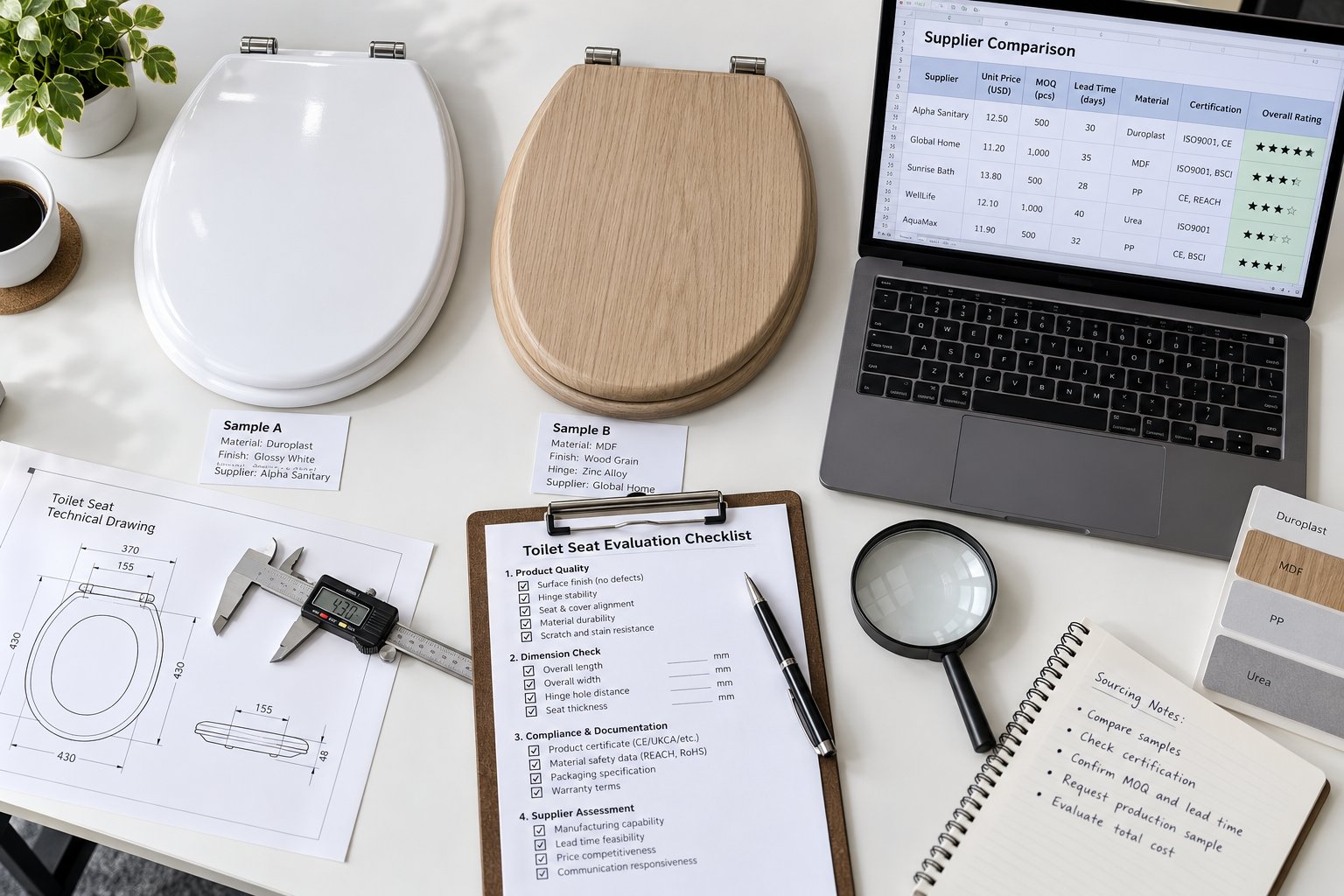
Knowing what certifications to look for and which sustainability practices matter gives you a solid framework — but the real test comes when you sit down to compare actual manufacturers against each other. The evaluation process, however, splits sharply depending on who you are. A procurement manager placing a 10,000-unit order for a hotel chain asks fundamentally different questions than a homeowner replacing a cracked seat on a Saturday afternoon. Both deserve clear, actionable criteria tailored to their reality.
What B2B Buyers Should Evaluate in a Manufacturer
If you source toilet seats at wholesale or OEM volume, the stakes are high and the margin for error is slim. A bad supplier choice does not just mean one disappointing product — it means thousands of defective units, missed project deadlines, and a commode blockage of your entire supply chain. Here are the most critical evaluation factors, ranked by their impact on long-term sourcing success:
- Production capability and factory scale — Verify that the manufacturer operates its own injection molding and compression molding equipment rather than outsourcing core production. A qualified factory should handle bulk orders of 10,000+ units with standard lead times remaining under 25 days. Request a factory tour — even a live video walkthrough — to confirm the infrastructure matches the claims.
- Customization capabilities — Can the manufacturer work from your CAD files, physical samples, or technical drawings? Clarify what is actually customizable: material (PP, UF, composite), seat shape, color, hinge configuration, logo placement, packaging, and installation instructions. As sourcing specialists emphasize, a supplier's ability to produce a standard product is fundamentally different from its ability to manage an OEM project from specification through mass production.
- Material and component transparency — Do not accept vague descriptions like "UF" or "PP" at face value. Two seats labeled identically can have completely different component configurations and production costs. Request a detailed specification sheet covering main material, product weight, hinge material, fixing hardware, soft-close mechanism, quick-release mechanism, and buffer components. This document becomes your baseline for quality comparison across suppliers.
- Quality control systems — Ask the factory to explain its QC process step by step, not simply claim "100% inspection." You want specifics: what gets checked during production, how dimensions are controlled, how hinges are tested, and how non-conforming products are handled. The key question is straightforward — how does the factory ensure the bulk order remains consistent with the approved sample? Retained samples and batch traceability systems are strong indicators of process discipline.
- Certifications and testing documentation — Confirm ISO 9001 quality management certification and cross-reference the company name with patent certificates and business registration records. For product-level assurance, ask about static load testing, hinge cycle testing, soft-close performance verification, and dimensional inspection — including the specific test method, frequency, and acceptance criteria.
- MOQ structure and cost transparency — Minimum order quantities often vary depending on whether you are ordering a standard model, a new color, a customized hinge, or a completely new mold. Confirm whether the quoted MOQ applies to one model, one color, or the entire order. Also ask whether tooling costs and development charges apply separately — this prevents a low initial quotation from becoming significantly more expensive once specifications are finalized.
- Lead time clarity — Pin down exactly when the clock starts. Does the quoted lead time begin from deposit receipt, specification approval, sample approval, or tooling completion? For OEM projects, separate tooling and sample-development time from mass-production lead time to build a realistic purchasing schedule.
- Communication quality and repeat-order consistency — This is easy to overlook and expensive to learn the hard way. A manufacturer that responds quickly, provides clear documentation, and maintains the approved specification across repeat orders six months or a year later is worth more than one offering a marginally lower unit price. Ask for reference customer contacts in your market segment.
For teams evaluating PP versus UF material options and developing seat and lid assemblies, manufacturer resource pages that consolidate material selection guidance, soft-close hinge matching, and OEM customization support can streamline the comparison process significantly. Tianyun's PP and UF Toilet Seat Cover Collection is one example of this kind of resource, designed specifically for sanitary ware manufacturers and bathroom brands working through these decisions. Pair it with your own specification requirements and the evaluation criteria above to build a complete supplier shortlist.
What Homeowners Should Look for in a Toilet Seat Brand
You do not need to audit a factory to buy a great toilet seat for your home — but you do need to ask the right questions before you hand over your credit card. Most homeowners discover they bought the wrong seat only after they get home and realize it does not fit, feels flimsy, or starts yellowing within a year. A few minutes of informed evaluation prevents all of that.
Start with these questions before purchasing:
- What material is the seat made from? — PP (polypropylene) is budget-friendly but may scratch and yellow over time. UF (duroplast) offers a heavier, more scratch-resistant, ceramic-like finish that holds up far longer. Know what you are getting before the packaging comes off.
- Is the shape round or elongated — and does it match my bowl? — This sounds obvious, but it is one of the most common return reasons. Round bowls measure about 16.5 inches in diameter, while elongated bowls run approximately 18.5 inches wide. Measure your bowl before you shop.
- What type of hinge does it use? — Soft-close hinges eliminate slamming and are worth the modest price premium for any household. Quick-release hinges let you pop the entire seat off for thorough cleaning — a feature you will appreciate more than you expect. Standard friction hinges cost less but offer neither benefit.
- What warranty does the manufacturer offer? — A confident brand stands behind its product. Look for warranty terms that cover structural defects, hinge mechanism failure, and surface degradation. Vague or absent warranty information is a red flag.
- Are replacement parts available? — Hinges wear out. Bumpers compress. Mounting hardware corrodes. A brand that sells replacement components separately saves you from buying an entirely new seat when a single part fails.
- Does the seat include installation hardware and clear instructions? — Most toilet seat replacements are DIY projects. Confirm that mounting bolts, wing nuts, and any necessary washers are included, along with step-by-step installation guidance.
- How does the finish hold up against cleaning products? — If you use bleach-based or antibacterial bathroom cleaners regularly, verify that the seat material resists chemical discoloration. UF and high-quality PP typically handle common cleaners well, but cheaper materials may not.
One practical tip: if you are unsure how to unclog a toilet without damaging the seat in the process — or you have dealt with repeated commode blockage situations that required aggressive plunging — prioritize a seat with a durable, scratch-resistant finish and a quick-release hinge. Rough maintenance is hard on fragile materials, and being able to remove the seat entirely makes cleanup after plumbing incidents dramatically easier.
Whether you are a B2B buyer building a supplier portfolio or a homeowner standing in the store aisle comparing two boxes, the principle is the same: the right manufacturer or brand is not the one with the lowest price tag. It is the one whose materials, engineering, certifications, and support infrastructure align with what you actually need the seat to do — and for how long you need it to do it.
Bringing It All Together for Smarter Sourcing Decisions
From raw plastic pellets to precision-molded seats with soft-close dampers and antimicrobial surfaces, the journey through this industry reveals something most buyers never see: every toilet seat replacement you make — or every thousand-unit order you place — connects back to decisions about materials, molding processes, hinge engineering, and manufacturer credibility that were made long before the product reached a shelf or a shipping container.
Key Takeaways for Every Buyer Type
The right toilet seat manufacturer depends on three things: your role (homeowner, contractor, or procurement professional), your material and feature requirements, and your volume needs — no single producer is the best fit for every scenario.
Here is what that principle looks like in practice. If you are a homeowner choosing between a durable UF seat and a budget-friendly PP option — or debating whether a wooden loo seat fits your bathroom's aesthetic — your priorities center on material quality, hinge type, shape compatibility, and warranty support. If you are a contractor specifying seats for a commercial build, compliance with building codes, open-front design mandates, heavy-duty hinge ratings, and ADA considerations take precedence. And if you are a B2B procurement manager, the evaluation widens to factory certifications, MOQ flexibility, OEM customization depth, lead time transparency, and long-term supply consistency.
Across every buyer type, the critical decision points remain the same: understand the four manufacturer business models (OEM, ODM, branded, private-label), evaluate materials based on your application's durability and hygiene demands, verify certifications through third-party documentation rather than marketing claims, and match features — soft-close, quick-release, antimicrobial, smart integration — to whether the seat serves a residential guest bathroom or a high-traffic institutional restroom.
Your Next Steps in Sourcing Toilet Seats
Knowledge without action stays theoretical. Here is how to turn everything you have learned into a concrete sourcing plan:
- Define your material, shape, and feature requirements — Decide whether PP, UF, wood, or composite best fits your application. Confirm whether you need round or elongated, and identify must-have features like soft-close dampers or quick-release hinges before you contact a single supplier.
- Request samples from two to three shortlisted manufacturers — Hold competing samples side by side. Compare weight, surface finish, hinge smoothness, and overall build quality. For B2B buyers, insist on production-representative samples rather than hand-finished prototypes.
- Verify certifications and testing documentation independently — Ask for copies of ISO certificates, product test reports, and compliance documentation relevant to your market. Cross-reference certificate numbers where possible rather than relying solely on claims made in sales materials.
- Compare hinge mechanisms under real-use conditions — Open and close each sample repeatedly. Test the soft-close at different release angles. Try the quick-release mechanism. The hinge is where long-term satisfaction — or frustration — lives, and no specification sheet substitutes for hands-on evaluation.
The toilet seat manufacturing industry rewards informed buyers. Whether your next move is a single toilet seat replacement for your home or a multi-thousand-unit procurement contract, the framework is the same — ask better questions, verify the answers, and let your specific needs guide every decision.
Frequently Asked Questions About Toilet Seat Manufacturers
1. What is the difference between OEM and ODM toilet seat manufacturers?
An OEM (Original Equipment Manufacturer) builds toilet seats to a buyer's exact design specifications, offering maximum customization but requiring higher minimum orders and longer lead times due to new mold development and prototyping. An ODM (Original Design Manufacturer) already has pre-designed, production-ready seats that buyers can rebrand with their own logo and packaging. ODM sourcing can reduce development timelines by 30 to 50 percent compared to full OEM projects, making it a lower-risk option for companies entering a new market or testing demand before committing to custom tooling investments.
2. What materials are most commonly used by toilet seat manufacturers?
The two dominant materials are polypropylene (PP) and urea-formaldehyde (UF, also called duroplast). PP is a lightweight, chemically resistant thermoplastic favored for budget and mid-range seats, typically retailing between $15 and $40. UF is a thermosetting plastic that produces a heavier, scratch-resistant, ceramic-like finish preferred for premium residential and commercial applications, generally priced between $20 and $70. Other materials include general thermoplast, solid wood for luxury or period-style bathrooms, MDF with protective coatings for traditional aesthetics, and engineered composites that blend performance characteristics for custom applications. Resources like Tianyun's PP and UF Toilet Seat Cover Collection (https://www.tianyuntech.com/pp-uf-cover) help sanitary ware manufacturers compare both material families and match them with appropriate soft-close hinge systems during product development.
3. How are toilet seats manufactured in a factory?
Toilet seat production follows a seven-stage process: raw material drying to remove moisture from plastic pellets, molding (injection molding for thermoplastics like PP or compression molding for thermosets like UF/duroplast), cooling and demolding to stabilize dimensions, post-processing including trimming and surface finishing, hinge assembly where soft-close or quick-release mechanisms are matched and installed, quality control testing covering load-bearing capacity, hinge cycle durability, chemical resistance, and dimensional accuracy, and finally packaging for distribution. The molding method is the most critical variable — injection molding offers faster cycle times and complex geometries, while compression molding produces denser, stronger seats with a premium ceramic-like feel.
4. What is the difference between residential and commercial toilet seats?
Residential toilet seats prioritize aesthetics, comfort features like soft-close lids and heated surfaces, and design variety in shapes and colors. They are rated for household-frequency use and typically last five to eight years. Commercial and institutional seats must meet stricter durability, hygiene, and code-compliance requirements. Many building codes mandate open-front (horseshoe-shaped) designs in public restrooms, and heavy-duty commercial seats often support 500 to 1,200 pounds compared to the 250-to-300-pound range of standard residential models. Commercial seats use vandal-resistant stainless steel hinges rated for hundreds of daily cycles and materials that withstand industrial-strength disinfectants without degradation.
5. What certifications should I look for when choosing a toilet seat manufacturer?
Key certifications include ASTM specifications for plastic toilet seat performance in North America, regional durability standards such as DIN 19516 in Europe or BS 1254 in the UK, and ISO 9001 for quality management systems. ISO 9001 confirms that a factory maintains consistent, traceable production processes but does not certify individual products — product-level test reports for load-bearing, hinge cycle durability, and chemical resistance should be requested separately. For commercial projects, verify ADA compliance for accessible design parameters. Always ask for third-party documentation rather than relying on marketing claims, and check whether the manufacturer maintains batch traceability and retained sample programs to ensure consistency beyond initial certification.
Apply This Insight to Your Project
Tell us what you are building and how the topic “Toilet Seat Manufacturers Exposed: From Raw Material To Your Bathroom” relates to your application. Our engineering team can help evaluate the next step.


