

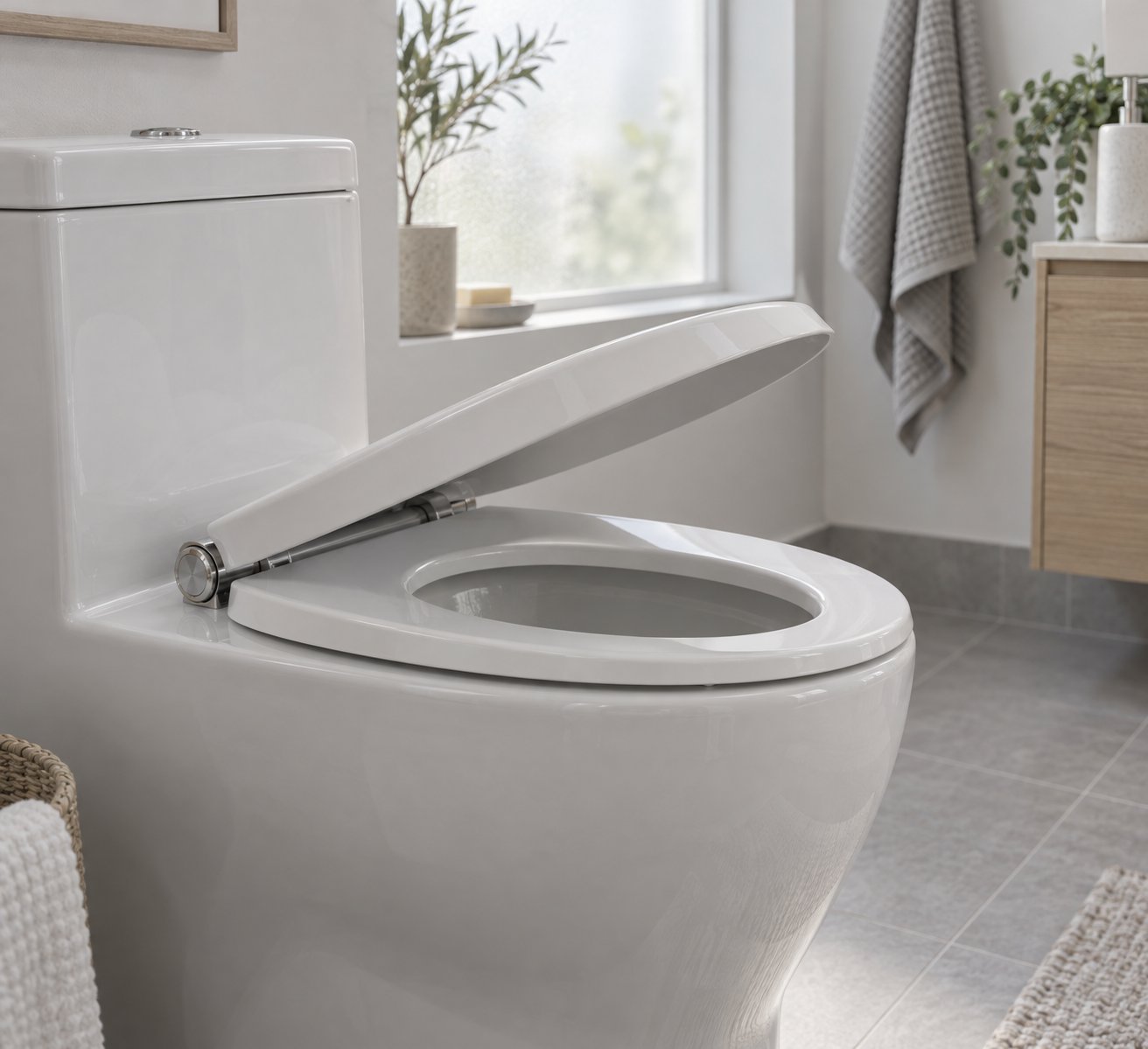
What Is a Slow Close Elongated Toilet Seat
Imagine this: it's 2 a.m., the house is silent, and then—BANG—the toilet lid crashes down like a cymbal in a library. A slow close toilet seat eliminates that jarring moment entirely. But what exactly makes it work, and why does the elongated shape matter so much?
A slow close toilet seat elongated is a toilet seat designed for oval-shaped (elongated) bowls that uses a damper-controlled hinge to lower the lid and seat ring gradually, preventing them from slamming shut.
What Does Slow Close Actually Mean
The magic behind a soft close toilet seat lives inside the hinge. A small rotary damper built into the hinge barrel creates controlled fluid resistance whenever the lid moves downward. When you give the seat a gentle nudge, that internal resistance absorbs the kinetic energy of the falling lid and converts a potential slam into a smooth, quiet descent. Think of it like a screen door that eases itself shut instead of snapping closed. This self lowering toilet seat design means you never have to guide the lid all the way down—just tap it and walk away.
Why the Elongated Shape Matters
Elongated bowls measure roughly 18.5 inches from the mounting bolt holes to the front rim, creating an oval profile that offers more seating surface and greater comfort than a round bowl. In the United States, this shape dominates homes built or remodeled after the 1970s, making the elongated slow close toilet seat the most universally relevant upgrade for modern bathrooms.
Pairing the elongated shape with a slow-close mechanism solves three problems at once. First, it eliminates startling noise—a huge win for shared bathrooms and open-plan living. Second, the controlled descent protects small fingers from getting pinched, a genuine safety concern in households with young children. Third, slow closing toilet seats reduce the repetitive impact that can chip porcelain rims and wear out hinge hardware over time.
Choosing the right elongated soft close toilet seat, however, involves more than picking the first option you see. Material composition, hinge quality, weight capacity, bowl compatibility, and long-term maintenance all play a role in how well that seat performs years down the road.
Elongated vs Round Toilet Seats and How to Tell Which You Have
Getting the right seat shape is the single most important compatibility decision you'll make—even more important than choosing between materials or hinge styles. An elongated seat on a round bowl creates an awkward two-inch overhang that can bend, crack, or look plain wrong. A round seat on an elongated bowl leaves the front of the porcelain exposed and eliminates the stability your seat needs for a reliable slow-close action. So before you shop, you need to know exactly which bowl you're working with.
How to Measure Your Toilet Bowl
Grab a tape measure and locate the two bolt holes at the back of the bowl—those are the holes where the seat hinges attach. Measure from the center point between those bolts straight forward to the very front edge of the bowl rim. That single number tells you almost everything you need to know.
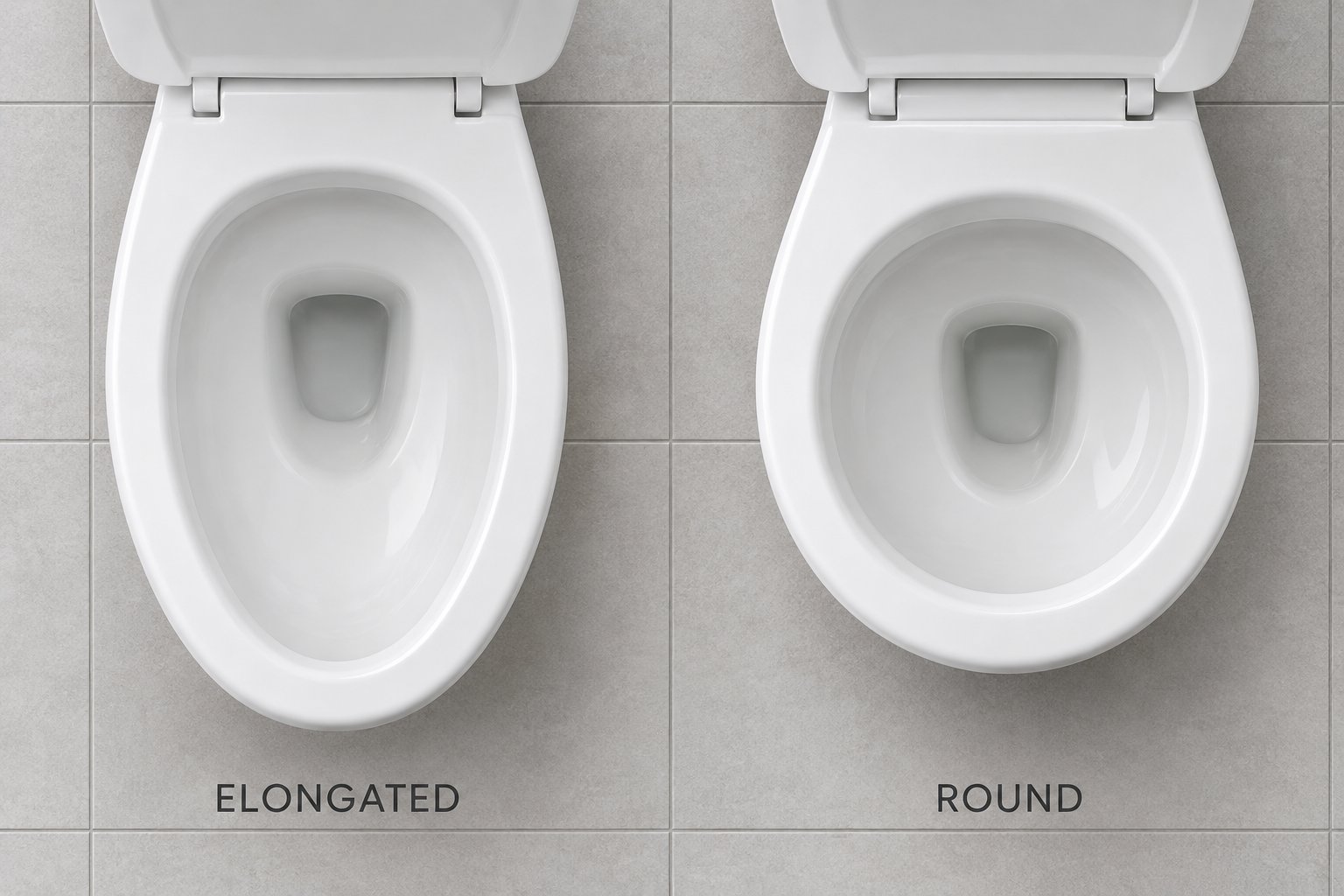
An elongated toilet bowl measures approximately 18.5 inches from the mounting holes to the front rim. A round toilet bowl measures about 16.5 inches. That two-inch difference might sound minor, but it completely changes the seat profile and determines which toilet seat elongated models will actually fit your bathroom.
Don't have a tape measure handy? Visual cues work surprisingly well. Stand directly over the bowl and look down. An elongated bowl has a distinctly oval, egg-like front that tapers to a slight point. A round bowl, by contrast, is nearly circular—shorter from front to back and more uniformly curved. If your home was built or remodeled after the 1970s in the United States, there's a strong chance you already have an elongated bowl, since this shape has dominated North American bathroom design for decades.
Elongated vs Round at a Glance
The table below breaks down the key differences so you can confirm your bowl type and understand what each shape means for comfort, space, and seat selection.
| Feature | Elongated | Round |
|---|---|---|
| Bowl Length (bolt holes to front rim) | ~18.5 inches (470 mm) | ~16.5 inches (419 mm) |
| Bolt Hole Spacing | 5.5 inches (standard) | 5.5 inches (standard) |
| Visual Shape | Oval / egg-like, tapered front | Nearly circular, uniformly curved |
| Comfort Level | More seating area, better thigh support | Adequate for most users, preferred by children |
| Space Required | Slightly more front-to-back clearance needed | Better for tight or small bathrooms |
| Common Brands Using This Shape | Kohler, TOTO, American Standard, Delta | Kohler, American Standard (older/compact models) |
| Seat Availability | Widest selection; most slow-close models designed for this shape | Fewer slow-close options available |
| Best For | Master baths, ADA-compliant setups, everyday comfort | Powder rooms, half-baths, children's bathrooms |
You'll notice the bolt hole spacing is identical for both shapes—5.5 inches is the North American standard. That means the mounting hardware is interchangeable, but the seat cover itself is not. An elongated seat paired with a long toilet seat hinge will physically bolt onto a round bowl, but the mismatch creates instability, cosmetic gaps, and premature wear on the slow-close damper.
Common Informal Names for Each Shape
Shopping for elongated toilet seats can get confusing because product listings, plumbers, and everyday conversations all use slightly different terminology. You might see an elongated seat described as an oblong toilet seat, an oval toilet seat, or simply a "long" seat. These are informal labels, not separate categories—they all refer to the same roughly 18.5-inch profile. Similarly, oval toilet seats is a phrase you'll encounter on marketplaces and in product reviews that means exactly the same thing as elongated.
Round bowls attract fewer nicknames, though you may hear them called "standard" or "regular" in older plumbing references. The important takeaway is this: whether a listing says "elongated," "oblong," or "oval," verify the stated bowl length measurement rather than relying on the label alone. A quick check against that 18.5-inch benchmark ensures the elongated seat you order will sit flush, stay stable, and allow the slow-close hinge to function exactly as intended.
Shape compatibility is the foundation, but the material that seat is made from determines how it feels, how long it lasts, and how well it supports the damper mechanism doing all the quiet closing work behind the scenes.
Key Benefits of a Slow Close Toilet Seat for Your Home
A slow close toilet seat elongated does more than just close quietly—it solves a handful of everyday frustrations that most homeowners don't realize they're living with until the fix is already in place. Whether you share a bathroom with a partner, have toddlers exploring everything within reach, or simply want your porcelain to last longer, the benefits stack up quickly.
Here's a closer look at the four core advantages that make a quiet close toilet seat one of the most practical bathroom upgrades available:
- Noise reduction — The damper-controlled hinge eliminates the sharp crack of a falling lid, replacing it with a near-silent descent. This is especially valuable in shared bathrooms, open-plan homes, and any household where a 2 a.m. slam can wake up the entire floor.
- Child and finger safety — A controlled closing action virtually removes the risk of pinched fingers. For families with curious toddlers who love to lift and drop the lid, a self closing toilet seat takes that hazard off the table.
- Reduced wear on porcelain — Every slam sends a sharp burst of force into the bowl rim. Over months and years, that repeated impact can chip glazing, stress hairline fractures, and leave visible marks. A no slam toilet seat absorbs that energy before it ever reaches the porcelain.
- Longer seat and hinge lifespan — Slam-induced vibration loosens bolts, fatigues plastic, and degrades damper fluid faster. Without that constant shock, hinges and seat materials retain their structural integrity much longer.
Noise Reduction and Household Calm
Picture an open-plan apartment where the bathroom sits just off the living area. A standard lid slamming shut during a dinner party or a late-night trip to the bathroom doesn't just create noise—it creates a small disruption that ripples through the entire space. A toilet seat quiet enough to go unnoticed changes the atmosphere of the room. You'll find that guests stop flinching, kids stop waking up, and you stop thinking twice about using the bathroom after everyone's asleep.
The difference is especially stark in homes with hard surfaces like tile and stone, where sound bounces and amplifies. A no slam toilet lid paired with an elongated bowl turns what used to be the loudest moment in the bathroom into something barely audible from the next room.
Child Safety and Pinch Prevention
Young children are naturally fascinated by lids that move, and a standard toilet seat becomes a genuine pinch hazard the moment a toddler learns to lift it. The weight of a heavy lid dropping onto small fingers can cause painful bruising or worse. Soft-close seats are specifically recommended for households with young children because the slow, controlled descent gives little hands plenty of time to move out of the way. The lid simply cannot free-fall—it eases down at a steady pace regardless of how it's released.
This isn't just a convenience for parents; it's a genuine safety upgrade. A slow shutting toilet seat means you don't have to hover over a child during every bathroom visit, and it quietly teaches better habits as kids learn to tap the lid and let it close on its own.
A slow close elongated toilet seat eliminates two of the most common bathroom complaints in one upgrade: startling noise that disrupts the household and a falling lid that puts small fingers at risk.
Protecting Your Porcelain and Extending Seat Life
Porcelain is tough, but it isn't invincible. Each time a heavy lid crashes down, the point of contact absorbs concentrated force. Over time, this can chip the glazed rim of the bowl—damage that's cosmetic at first but can eventually expose the porous ceramic underneath to moisture and staining. A no slam toilet seat removes that repeated impact entirely, keeping the bowl rim smooth and intact for years longer than a standard seat would allow.
The seat itself benefits just as much. Quality slow-close hinges are rated for roughly 40,000 to 55,000 open-and-close cycles before the damper needs attention. Without slam-induced stress, bolts stay tight, plastic stays free of micro-fractures, and the damper fluid inside the hinge maintains consistent resistance. Toilet seats soft closing gently cycle after cycle simply wear out more slowly than seats that absorb a jolt every single time they're used.
These benefits hold true across every price tier and material type. But the specific material your seat is made from—polypropylene, urea-formaldehyde, molded wood, or something else—affects exactly how much durability, comfort, and scratch resistance you'll get from that gentle closing action.
Comparing Seat Materials for Elongated Slow Close Models
The material underneath your fingertips every time you lift or lower the lid shapes everything about how a soft close toilet seat elongated performs over time—scratch resistance, temperature comfort, weight, color stability, and even how well the slow-close damper functions. Yet most buyers never think past "white plastic" when choosing a seat. Here's what actually separates one material from another.
Polypropylene PP vs Urea-Formaldehyde UF
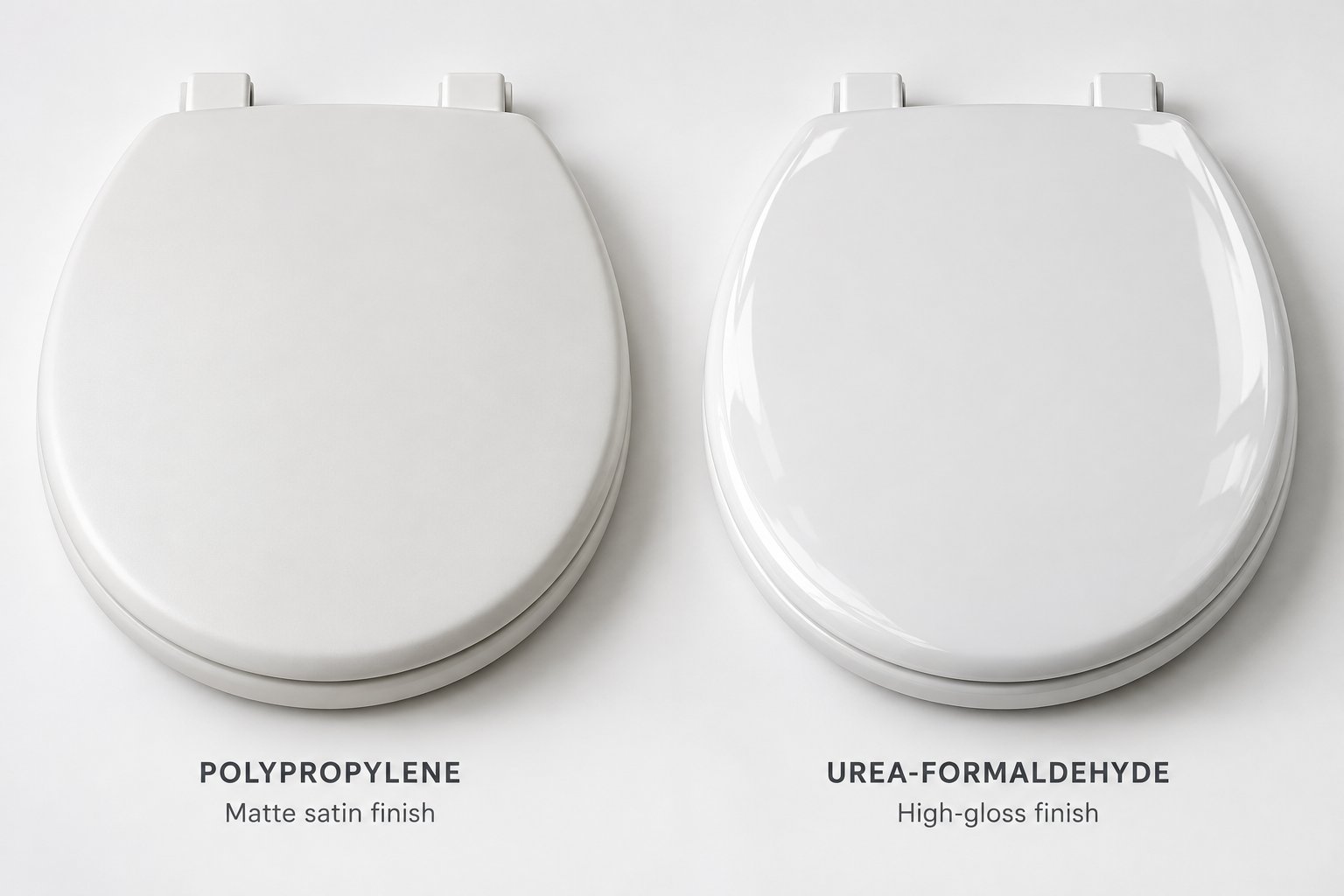
These two plastics dominate the soft close toilet seats market, and for good reason. Polypropylene (PP) is a thermoplastic polymer manufactured through injection molding. It's lightweight, chemically resistant, and affordable—qualities that make it the go-to material for budget-friendly and mid-range plastic elongated toilet seat options. PP handles household cleaners without degrading, flexes slightly under load instead of cracking, and ships at lower cost because it weighs less. The tradeoff? Its softer surface can pick up fine scratches over the years, and its matte or satin finish doesn't quite mimic the look of porcelain.
Urea-formaldehyde (UF), also called Duroplast, sits at the premium end of the spectrum. It's a thermosetting plastic compressed under high heat and pressure into a rigid, exceptionally hard structure. The result is a glossy, ceramic-like surface with very high scratch resistance and a non-porous finish that resists bacteria and staining. UF seats feel noticeably heavier—closer in heft to porcelain itself—which many homeowners interpret as a sign of quality. That added weight also means thick toilet seats made from UF place slightly more demand on the damper hinge, requiring a well-calibrated mechanism to maintain a smooth, controlled descent.
Both materials are widely used by OEM toilet seat manufacturers for production-ready slow-close programs. Tianyun's PP and UF seat cover line illustrates this pairing effectively: each seat cover is engineered to integrate with matched dampers, hinges, and fixing systems, giving sanitaryware brands a turnkey slow-close package where material choice and hinge calibration work together from the factory floor.
Wood and Specialty Seat Materials
Beyond plastics, you'll encounter three other materials in the elongated seat aisle:
- Molded wood (MDF core with veneer or lacquer) — Offers a warm, natural aesthetic and a heavier, solid feel. Molded wood resists temperature shock better than raw timber, but its compressed-fiber core can swell if moisture penetrates cracked lacquer. It pairs adequately with slow-close hinges, though the extra weight demands a stronger damper.
- Enameled wood — A step up from basic molded wood, featuring a baked enamel coating for improved moisture protection and a smoother surface. Color stability is good, but a sharp impact can chip the enamel layer and expose the wood beneath to water damage over time.
- Cushioned vinyl — A foam-padded seat wrapped in vinyl upholstery. It's soft, warm to the touch, and popular in guest bathrooms. However, vinyl surfaces are prone to cracking and peeling after a few years, and the added cushion thickness can interfere with hinge alignment on some toilet seat cover soft close models, potentially shortening damper life.
Material Comparison at a Glance
| Material | Durability | Weight | Aesthetics | Ease of Cleaning | Best Use Case |
|---|---|---|---|---|---|
| PP (Tianyun) | Good — flexible, impact-resistant | Light | Matte/satin finish | Excellent — chemical-resistant | Budget to mid-range soft close elongated toilet seat programs |
| UF/Duroplast (Tianyun) | Excellent — very hard, scratch-resistant | Heavier | Glossy, ceramic-like | Excellent — non-porous surface | Premium soft close toilet seats and commercial projects |
| Molded Wood | Moderate — vulnerable if lacquer cracks | Heavy | Natural wood grain | Good — smooth lacquer surface | Traditional or rustic bathroom designs |
| Enameled Wood | Moderate to Good — enamel adds protection | Heavy | Smooth, painted finish | Good — wipe-clean enamel | Decorative or color-matched bathrooms |
| Cushioned Vinyl | Low — vinyl cracks and peels over time | Medium | Padded, soft appearance | Fair — seams can trap moisture | Guest baths, short-term comfort priority |
Which Material Works Best for Slow Close Mechanisms
Slow-close dampers are calibrated to handle a specific weight range. Too light, and the lid drops faster than the damper can control. Too heavy, and the mechanism strains, shortening its service life. This is why PP and UF have become the industry standard for soft close toilet seats—their weight falls squarely in the sweet spot that modern hydraulic dampers are designed around.
PP's lighter mass pairs naturally with compact dampers, keeping manufacturing costs down while still delivering a smooth, consistent close. UF's greater heft requires a slightly more robust damper, but the payoff is a seat that feels solid, resists everyday wear, and maintains its glossy appearance for years. In production environments like Tianyun's integrated seat cover programs, each material is matched to a damper tuned specifically for its weight and density—an approach that explains why factory-paired systems tend to outlast aftermarket combinations where the seat and hinge come from different sources.
Wood-based and vinyl-cushioned seats can work with slow-close hinges, but they introduce variables—moisture expansion, shifting weight from padding compression, enamel chips altering the lid's balance point—that make long-term damper performance less predictable.
Material choice sets the stage for how a seat looks and lasts, but the real engine behind that whisper-quiet descent is the hinge mechanism itself—and not all hinges are created equal.
Understanding Slow Close Hinge Types and Quality Differences
Every slow close toilet seat elongated owes its whisper-quiet performance to a single component hidden inside the hinge assembly: the damper. Strip away the marketing language, and the difference between a seat that closes silently for five years and one that starts slamming after six months almost always comes down to how that damper is built, where it's positioned, and how well it's matched to the seat's weight. Here's what's actually going on inside those hinges—and why it matters more than most buyers realize.
How Hydraulic Damper Hinges Work
Imagine a tiny piston sealed inside a cylinder filled with viscous silicone fluid. When you nudge the lid, gravity pulls it downward, and that piston is forced through the fluid. The resistance of the fluid against the piston is what converts a free-fall slam into a slow, controlled descent—typically taking anywhere from three to seven seconds depending on the damper's calibration. This is the same basic principle behind a screen door closer or the soft-close drawer slides in your kitchen, just miniaturized to fit inside a toilet seat hinge barrel.
Three main damper configurations dominate the market:
- Integrated hydraulic dampers — The damper mechanism is built directly into the hinge barrel itself. This is the most common design in mid-range and premium seats. Because the damper and hinge pivot share a single housing, alignment stays tight, and the closing action feels smooth and consistent. Most modern soft close toilet seat hinge systems use this approach.
- External clip-on dampers — A separate damper cartridge clips onto or beside an otherwise standard hinge. You'll find this configuration on budget-priced seats and retrofit kits that convert a traditional toilet seat into a slow-closing one. The advantage is low cost; the drawback is that clip-on units are more exposed to moisture, mineral buildup, and physical impact—all of which shorten damper life.
- Multi-pivot (dual-damper) hinges — Premium seats often feature two independent damper channels: one controlling the lid and another controlling the seat ring. This means the lid can close on its own without dragging the seat ring down with it, and vice versa. It's a small detail that dramatically improves everyday usability, especially in households where the seat ring stays down most of the time while only the lid gets raised and lowered.
A well-engineered slow close toilet seat hinge uses a sealed damper with precision-machined tolerances. That seal is critical—it keeps the silicone fluid contained and prevents air from entering the cylinder, which would cause inconsistent closing speed or a sudden loss of resistance. Think of it as the difference between a hydraulic car jack that holds steady under load and a cheap one that slowly sinks. The engineering principle is identical; only the scale differs.
Quick-Release Hinges and Easy Cleaning
If you've ever tried scrubbing around the back of a toilet seat where the hinges meet the bowl, you know the frustration. Grime, mineral deposits, and moisture collect in that tight gap, and no amount of angled wiping gets it truly clean. Quick-release hinges solve this problem elegantly.
Most modern slow-close elongated seats feature push-button hinges that let you lift the entire seat off the mounting plate without tools. Press the button on each hinge, slide the seat forward or upward, and the whole assembly—lid, seat ring, and hinge arms—detaches in seconds. The mounting plate stays bolted to the bowl, and you can clean every surface thoroughly before snapping the seat back into place. It's a feature you'll see listed in countless product descriptions as "easy-clean" or "quick-release," but few listings explain that this design also protects the slow-close mechanism itself. Mineral buildup around the hinge pivot is one of the most common reasons a slow closing toilet lid begins to resist, creak, or lose its controlled descent. Regular removal and cleaning prevents that buildup from ever reaching the damper.
The quick-release mechanism also simplifies seat replacement down the road. When a toilet seat closer eventually wears out—and every mechanical component does eventually—you simply unclip the old seat and clip on the new one. No wrestling with corroded bolts, no awkward under-bowl reach. The whole swap takes minutes.
Budget vs Premium Hinge Quality
Price differences between slow-close seats often reflect hinge quality more than seat material. A budget seat and a premium seat can both be made from polypropylene, yet the premium model may cost twice as much because its damper is sealed with tighter tolerances, uses higher-grade silicone fluid, and features corrosion-resistant stainless steel or zinc-alloy hardware instead of bare steel screws that rust within a year.
Here's what separates the two tiers in practical terms: cheaper dampers may lose their resistance within 12 to 18 months of regular household use. The silicone fluid leaks past worn seals, air enters the cylinder, and the auto toilet lid closer effect gradually fades until the lid free-falls just like a standard seat. Well-engineered dampers, by contrast, are rated to maintain consistent closing speed across 40,000 to 55,000 open-and-close cycles—translating to many years of daily use before any degradation becomes noticeable.
When you're evaluating an automatic toilet seat closer or any self closing toilet lid mechanism, look for these hallmarks of premium hinge construction:
- Consistent closing speed — The lid and seat ring descend at the same controlled pace whether the bathroom is cold in winter or warm in summer. High-quality silicone fluid maintains viscosity across temperature changes.
- Independent lid-and-ring control — Each piece closes on its own via a dedicated damper channel, eliminating the awkward dual-drop of cheaper single-damper designs.
- Corrosion-resistant hardware — Stainless steel or zinc-alloy bolts, nuts, and hinge pins that resist bathroom humidity and cleaning product exposure.
- Quick-release button — A tool-free detachment feature for easy cleaning and hassle-free replacement.
- Sealed damper housing — No visible seams or gaps where fluid could seep out or mineral-laden water could seep in.
A seat equipped with all five of these features represents the current gold standard for an auto close toilet seat. It won't be the cheapest option on the shelf, but it will outperform and outlast two or three budget replacements over the same period—making it the more economical choice in the long run.
Hinge engineering controls how smoothly and how long your seat closes quietly, but it doesn't address another critical performance factor: how much weight those hinges can handle day after day without losing their precision.
Weight Capacity and Heavy Duty Durability Considerations
A slow close toilet seat elongated can have the smoothest damper on the market, but if the seat flexes, shifts, or cracks under load, that gentle closing action won't matter for long. Weight capacity is the structural backbone behind every other feature—and it's one of the most misunderstood specifications in the bathroom aisle.
What Heavy Duty Really Means in Toilet Seats
The phrase "heavy duty" gets tossed around loosely in product listings, but in engineering terms, a heavy duty toilet seat differs from a standard model in four measurable ways:
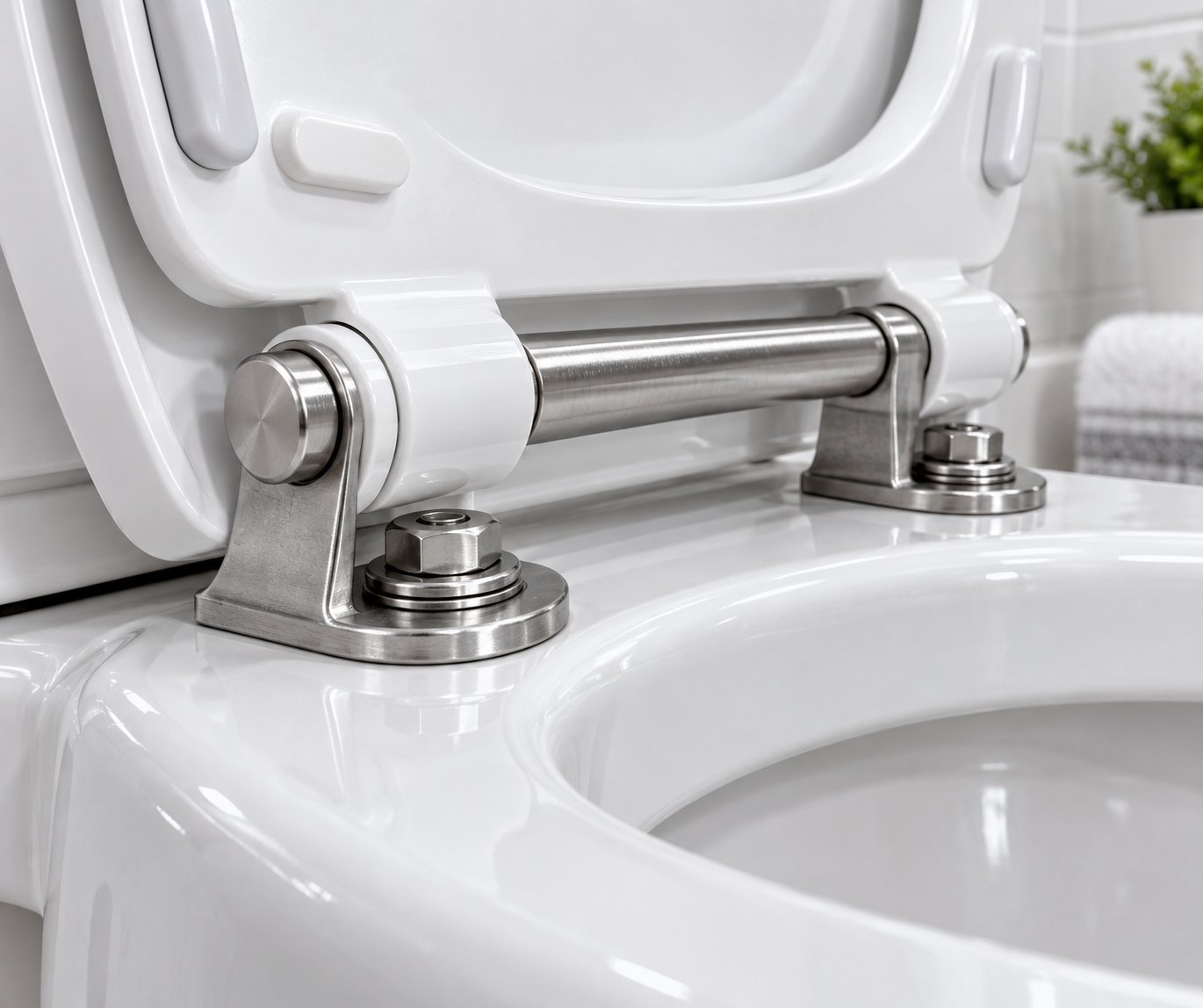
- Reinforced hinge posts — Standard seats use plastic mounting posts that can flex under heavier loads. Heavy-duty versions upgrade to steel-reinforced or solid zinc-alloy posts that distribute stress evenly and resist cracking at the bolt holes.
- Thicker seat-ring cross sections — The ring you sit on is wider and denser, often molded with internal ribbing or a solid core. This added thickness eliminates the subtle bowing that lighter seats develop over time, even under moderate weight.
- Steel bolt hardware — Instead of nylon or ABS plastic bolts, a heavy duty elongated toilet seat typically ships with stainless steel or chrome-plated steel fasteners. These resist shearing forces and won't snap if over-tightened during installation.
- Higher-rated dampers — The hydraulic damper must handle additional gravitational force from both the heavier seat and the user pressing down during sitting. Premium heavy-duty seats pair their thicker construction with dampers calibrated for that extra load, maintaining controlled descent instead of overwhelming the mechanism.
Weight Ratings and Build Quality
Standard residential toilet seats typically carry a weight rating around 300 pounds. That number represents a tested structural limit, not a rough guess—though how much testing sits behind any given number varies by manufacturer. Heavy-duty models push that capacity to 400 pounds or higher, while bariatric-rated products designed as a toilet seat for heavy person use can reach 500 or even 600 pounds.
What's interesting is that these tiers aren't just the same seat stamped with a bigger number. Moving from a 300-pound standard rating to a 500-pound heavy-duty rating usually means genuinely different frame material, mounting hardware, and structural reinforcement—a distinction important enough that Medicare's own billing system treats "extra wide and/or heavy duty" commode equipment as a separate product category entirely.
Here's the detail most shoppers miss: a higher weight rating often signals better overall build quality, even for average-weight users. An elongated toilet seat heavy duty model built with thicker walls, steel bolts, and a robust damper simply resists flexing, cracking, and wobbling better than a seat engineered to the bare minimum. If you've ever sat on a cheap seat and felt it bow slightly beneath you, that flex is exactly what heavy-duty construction eliminates. Over thousands of sitting cycles, that rigidity also protects the slow-close hinge from misalignment—keeping the damper performing smoothly far longer.
For households shopping for an oversized toilet seat or comparing extra large toilet seats, pay close attention to whether the listed weight capacity covers the full mounted assembly or just the seat itself. A product rated at 500 pounds means less if the plastic bolts holding it to the bowl can only handle 250. The strongest seats treat capacity as a system specification—seat ring, hinge, hardware, and mounting plate all rated together.
Accessibility and Elevated Seat Options
Weight capacity intersects directly with accessibility. Raised or elevated slow-close elongated seats serve elderly users and individuals with mobility challenges by adding two to four inches of height, reducing the distance required to sit or stand and easing pressure on joints and muscles. That added height also improves balance and control during transfers—a critical safety factor for anyone recovering from hip or knee surgery.
An oversize toilet seat or a heavy duty commercial toilet seat designed for public restrooms and healthcare facilities often combines elevated height with a bariatric weight rating. These models feature wider seating surfaces, reinforced mounting brackets, and dampers engineered for high-frequency use across multiple users per day. Even for home use, choosing a seat with some of these commercial-grade features—steel hardware, reinforced hinge posts, a rated weight capacity well above your actual need—provides a durability margin that budget seats simply can't match.
Here's a quick checklist of heavy-duty features to look for before you buy:
- Published weight capacity of 400 lbs or higher with a named test methodology
- Stainless steel or zinc-alloy bolt hardware (not nylon or ABS plastic)
- Thickened seat ring with internal ribbing or solid-core construction
- Reinforced hinge posts rated for the stated capacity
- Damper calibrated for the seat's actual assembled weight
- Elevated height option if accessibility is a consideration
- System-level rating that includes seat, hinge, and mounting hardware together
Weight capacity tells you how strong the seat is, but it won't help if the seat doesn't physically fit your toilet. Bolt spacing, bowl contour, and tank clearance all need to line up before any of these heavy-duty features can do their job—and that's where compatibility and proper installation come into play.
Compatibility and Installation for Elongated Slow Close Seats
You've picked the right shape, chosen a quality material, verified the weight rating, and confirmed the hinge type. But none of that matters if the seat doesn't physically match the toilet it's supposed to sit on. A toilet seat with slow close hinges can only deliver its quiet, controlled descent when it's mounted securely, aligned precisely, and bolted to a bowl that matches its footprint. Compatibility is where careful planning meets practical reality—and where skipping a few simple checks leads to wobble, gaps, and premature damper failure.
Confirming Bolt Spacing and Bowl Contour
Most elongated toilet seat slow close models sold in North America use a standard two-bolt mounting system with bolts spaced roughly 5.5 inches apart, center to center. That measurement has been the dominant standard for decades, so the majority of toilets you'll encounter in U.S. homes will match. But "majority" isn't "all."
Variations crop up in a few specific scenarios:
- European-style toilets — Some European and Australian models use narrower or wider bolt spacing. If your toilet was imported or your bathroom was designed around European fixtures, grab a tape measure and check rather than assuming the 5.5-inch standard applies.
- Wall-hung toilets — These increasingly popular models mount directly to the wall with a concealed carrier frame. Their bolt spacing may match the North American standard, but the bowl contour, rim profile, and clearance around the mounting area can differ significantly from floor-mounted toilets.
- Top-fix vs bottom-fix hardware — This is a compatibility detail that catches many buyers off guard. A top-fix toilet seat installs entirely from above using expanding anchors that grip inside the bolt holes—no access to the underside of the bowl needed. A bottom-fix seat uses the traditional approach: bolts drop through from above, and you tighten nuts from underneath. Modern back-to-wall and skirted toilets with enclosed bases often require top-fix hardware because there's simply no way to reach beneath the bowl. If your toilet has an enclosed or skirted base, confirm that your elongated toilet seat replacement comes with top-fix fittings—or buy a compatible top-fix kit separately.
Beyond bolt spacing and fixing type, bowl contour plays a surprisingly important role. Some toilet seats have a flat underside designed for bowls with a level, uniform rim. Others feature a slightly contoured underside that conforms to bowls with a raised or sculpted rim edge. When a flat-bottomed seat lands on a deeply contoured rim, it may rock side to side, create visible gaps along the edges, or fail to distribute weight evenly—all of which stress the slow-close hinges and accelerate wear.
Finally, check clearance behind the tank. The hinge assembly of a toilet seat with soft close mechanisms extends a small distance behind the bolt holes. If your toilet tank sits very close to the back of the bowl—or if a wall-mounted tank leaves minimal space—the hinge may not have room to open fully or could press against the tank during use. A quick dry fit before committing to final installation saves a lot of frustration.
Step-by-Step Installation Process
Installing an elongated slow close toilet seat is genuinely straightforward—most homeowners can handle it with no special tools in 10 to 15 minutes. Here's the process from start to finish:
- Remove the old seat. Locate the bolts at the back of the bowl. For bottom-fix seats, reach underneath and unscrew the nuts while holding the bolt heads steady from above. For top-fix seats, pry off the hinge caps and unscrew the top-mounted fasteners. If the bolts are corroded, a penetrating lubricant and a few minutes of patience usually free them up.
- Clean the mounting area. With the old seat removed, you'll likely find a buildup of grime, mineral deposits, and old sealant around the bolt holes and along the back edge of the rim. Wipe everything down with warm soapy water or a mild bathroom cleaner. This step ensures the new seat sits flush and prevents debris from interfering with bolt alignment.
- Position the new seat. Set the toilet seat elongated slow close model onto the bowl without inserting any bolts yet. Align the bolt holes, check that the seat sits centered on the rim with even overhang on both sides, and verify that the front of the seat follows the bowl's curve without gaps or overhangs.
- Insert and hand-tighten the bolts. Drop the bolts through the hinge assembly and into the bowl's mounting holes. Thread the nuts on by hand—bottom-fix style—or engage the expanding anchors from above for top-fix models. Finger-tight is the goal at this stage. Do not use tools yet.
- Adjust alignment. With the bolts loosely in place, slide the seat forward, backward, or side to side until it's perfectly centered. Most slow-close seats have slotted bolt holes in the hinge plate specifically to allow this fine adjustment. Take your time here—alignment affects how evenly the lid and seat ring close.
- Snug the hardware. Once the seat is centered, tighten the bolts gradually and evenly—alternating between left and right—until the seat feels secure and doesn't shift when you press down on the front edge. Use a screwdriver or wrench appropriate for the hardware, but stop as soon as the seat is firm.
After installation, test the slow-close action by lifting the lid to its fully open position and letting it go. It should descend smoothly and evenly without veering to one side. If the lid drifts left or right, one bolt is likely tighter than the other—loosen the tighter side slightly and re-test until the descent is straight.
Common Installation Mistakes to Avoid
A toilet with slow close lid functionality depends on precise hinge alignment, and even small installation errors can compromise it. Here are the pitfalls that trip up the most homeowners:
- Over-tightening plastic bolts. This is the most common mistake and the most damaging. Plastic bolts are designed to hold the seat firmly without cracking the porcelain or the bolt itself. Cranking them down with pliers or an oversized wrench can split the bolt, crack the mounting plate, or torque the hinge assembly out of alignment—any of which ruins the slow-close mechanism's ability to lower the lid evenly. Fittings that don't match well or are over-stressed during installation are one of the leading causes of seats that start shifting and loosening within the first week.
- Skipping the dry fit. Bolting a new seat directly onto the bowl without first checking contour, clearance, and alignment wastes time and risks stripping the hardware if you have to remove and reposition it.
- Ignoring fixing-system type. Trying to install a bottom-fix seat on a toilet with slow close seat hardware designed for top-fix mounting—or vice versa—results in either an impossible installation or a wobbly fit that never feels right. Always confirm whether your toilet requires top-fix or bottom-fix hardware before ordering.
- Using mismatched replacement bolts. If the original bolts are lost or damaged, resist the urge to substitute generic hardware-store bolts. Slow-close hinges are calibrated to work with specific bolt lengths and thread pitches. Mismatched fasteners can alter the hinge angle and throw off the damper's closing speed.
- Forgetting tank clearance. A hinge assembly that bumps the tank every time the lid opens will eventually crack the hinge housing or chip the tank's glazing. Measure the gap between the back of the bowl rim and the front of the tank before you commit to a particular seat model.
The right fixing system matters just as much as the seat itself. A perfectly engineered damper paired with premium materials will underperform if it's mounted with the wrong hardware or installed with sloppy alignment. Getting installation right from the start is what separates an elongated toilet seat replacement that feels rock-solid for years from one that starts wobbling within weeks.
With the seat securely installed and the slow-close action verified, the final challenge is knowing exactly what to prioritize when you're standing in the aisle—or scrolling through listings—trying to compare dozens of options that all claim to be the best.
What to Look For When Shopping for the Right Seat
Dozens of options, nearly identical product photos, and a wall of spec sheets that blur together after the third listing. Shopping for a slow close elongated toilet seat can feel overwhelming precisely because so many models look the same on the surface. The differences that actually matter—damper calibration, bolt compatibility, material density—hide behind identical-sounding product titles. What you need is a single, structured framework that cuts through the noise and lets you compare any two seats on the factors that determine real-world performance.
The Essential Buyer's Checklist
Before you click "add to cart"—whether you're browsing elongated toilet seats Amazon listings or visiting a local plumbing supply store—run every candidate through these nine decision points. Each one addresses a specific failure mode that leads to returns, wobble, noise, or premature replacement.
- Hinge type and damper quality — Is the damper integrated into the hinge barrel, or is it an external clip-on unit? Integrated hydraulic dampers with sealed housings deliver the most consistent, longest-lasting toilet seat slow close action. Look for dual-damper designs that let the lid and seat ring close independently.
- Seat material (PP vs UF vs wood) — Polypropylene (PP) offers lightweight durability and chemical resistance at a budget-friendly price. Urea-formaldehyde (UF/Duroplast) delivers a heavier, glossy, ceramic-like feel with superior scratch resistance. Wood-based options add warmth but introduce moisture risk. Your material choice directly affects damper calibration, so a toilet seat soft close mechanism must be matched to the weight of the cover it's controlling.
- Weight rating — Standard seats typically handle around 300 lbs; heavy-duty models push to 400 lbs or more. Even if your household doesn't need the maximum rating, a higher-rated seat signals thicker construction and more durable hardware overall.
- Bolt compatibility and fixing system — Confirm whether your toilet requires top-fix or bottom-fix mounting. Measure the bolt hole spacing—5.5 inches center-to-center is the North American standard, but European and wall-hung models may differ. The wrong fixing system turns an otherwise perfect seat into a compatibility nightmare.
- Quick-release feature — Push-button hinges that let you lift the entire seat off the bowl without tools make thorough cleaning dramatically easier. This feature also simplifies future replacement. If two soft closing toilet seat models are otherwise equal, the one with quick-release wins every time.
- Color match — "White" is not universal. Cotton white, bone, biscuit, and linen are all distinct shades that vary across manufacturers. If possible, compare the seat against your bowl in person or request a sample chip. A mismatched white is surprisingly noticeable and difficult to un-see once installed.
- Warranty length — A manufacturer willing to back a softclose toilet seat with a multi-year warranty is signaling confidence in its damper longevity and material durability. One-year warranties on the hinge mechanism should raise a flag—quality dampers are rated for tens of thousands of cycles, and a short warranty suggests the manufacturer expects early failure.
- Brand reputation and parts availability — A toilet seats soft close model from a reputable brand or established OEM manufacturer means replacement dampers, bolts, and bumpers will be available years from now. Obscure brands with no parts pipeline leave you replacing the entire seat the moment one component fails.
- Bowl contour compatibility — Beyond bolt spacing, check whether the seat's underside profile matches your bowl rim. A flat-bottomed seat on a deeply contoured rim rocks and gaps; a contoured seat on a flat rim may not sit flush. A quick dry fit before final installation catches this issue early.
Print this list or save it on your phone before you shop. It takes less than five minutes to evaluate any seat against these criteria—and those five minutes can save you from a return, a re-install, or a seat that starts slamming within a year.
The best slow close toilet seat elongated balances material quality, damper engineering, and a fixing system designed to work together as a unified system—not as isolated components sourced from different suppliers.
Why a Systems Approach to Seat Design Matters
Here's a pattern that plays out constantly in amazon slow close toilet seat reviews: a buyer picks a seat with a great-looking cover, pairs it with aftermarket hinges from a different brand, and uses generic hardware-store bolts to mount it. Each component might be perfectly fine on its own, but together they create a mismatch. The damper is calibrated for a lid heavier or lighter than the one attached to it. The bolt length throws off the hinge angle by a fraction of a degree. The seat closes unevenly, the damper wears prematurely, and within 18 months the whole assembly needs replacing.
This is why the most reliable toilet seat slow close assemblies aren't built from mix-and-match parts—they're engineered as complete systems. When the seat cover, damper, hinge barrel, and fixing hardware are designed, tested, and calibrated as a single package, every variable is accounted for. The damper torque matches the exact weight of the lid it's controlling. The bolt length and thread pitch align precisely with the hinge plate's mounting geometry. The result is a closing action that stays consistent across thousands of cycles rather than degrading as mismatched tolerances compound over time.
Tianyun's PP and UF seat cover program is a clear example of this integrated philosophy in practice. Rather than selling seat covers as standalone components, Tianyun engineers each cover—whether lightweight PP or heavier UF—alongside its matched dampers, hinges, and fixing systems as a single production-ready package. For OEM toilet seat manufacturers and sanitaryware brands building their product lines, this approach eliminates the compatibility guesswork that plagues piecemeal sourcing. The damper doesn't need field adjustment because it was calibrated for that specific cover's weight during development. The fixing system doesn't need adaptation because it was designed around that specific hinge geometry from day one.
This systems thinking applies at the consumer level too. When you're evaluating a soft closing toilet seat, ask yourself whether the product was designed as an integrated unit or assembled from separately sourced parts. Seats where the manufacturer controls the entire chain—cover molding, damper selection, hinge engineering, and hardware specification—tend to deliver smoother closing action out of the box and maintain it for significantly longer. It's the difference between a well-tuned instrument and a collection of parts that happen to be in the same box.
The checklist above captures what to evaluate before you buy. But even the best-chosen seat will eventually need attention—dampers age, minerals accumulate, and bolts loosen over time. Knowing how to maintain your investment and troubleshoot the inevitable hiccups is what keeps a quality seat performing quietly for years instead of months.
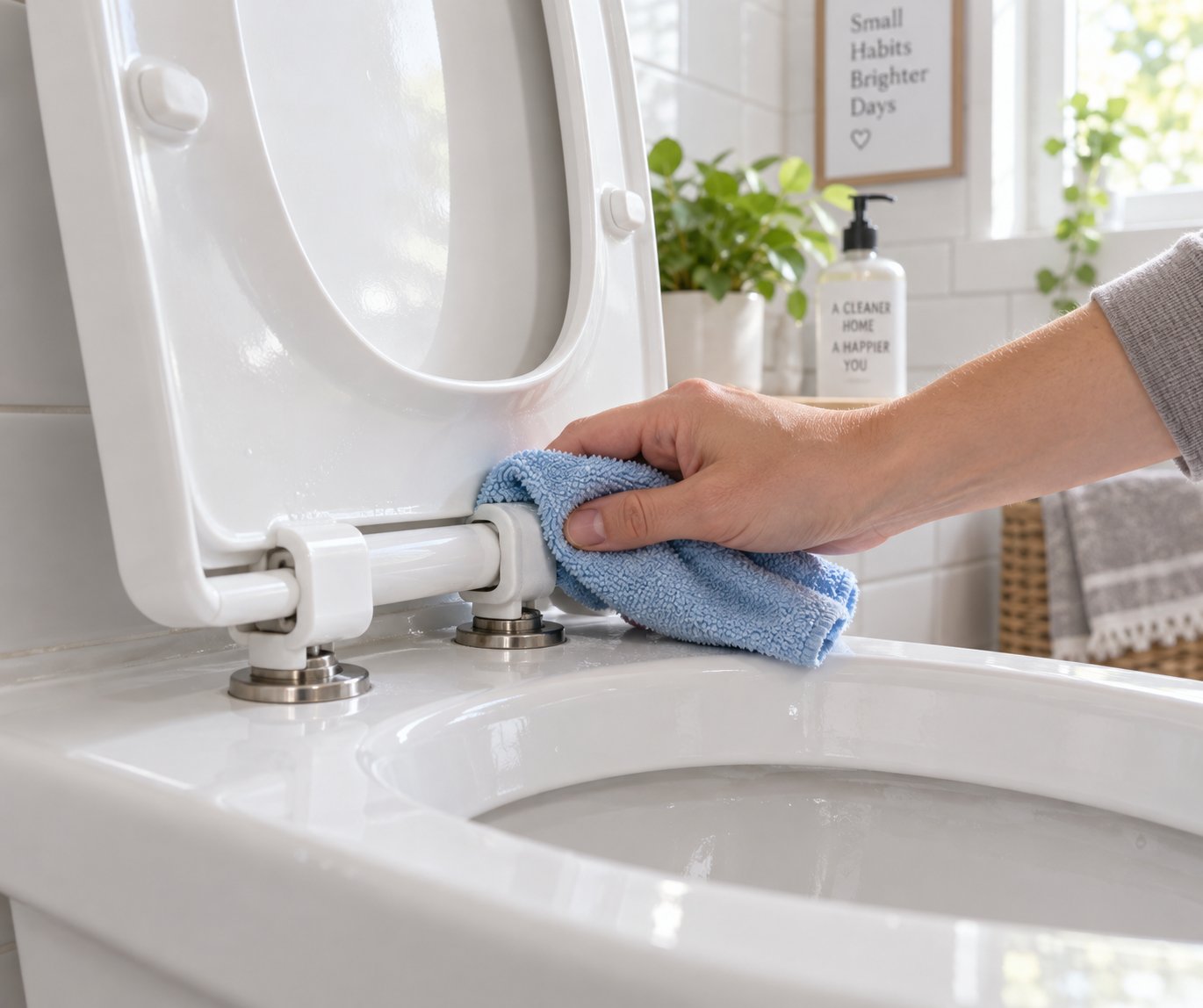
Troubleshooting and Maintaining Your Slow Close Toilet Seat
A quality slow closing toilet seat should deliver years of quiet, consistent performance right out of the box. But "years" isn't "forever." Every mechanical component eventually shows wear, and the damper inside your hinge is no exception. The good news? Most problems have obvious warning signs and straightforward fixes—if you know what to look for. The bad news? Most homeowners don't learn any of this until the midnight slam returns and they're right back where they started.
Why Your Slow Close Seat Starts Slamming
You installed the seat two years ago, and it's been flawless. Then one morning the lid drops the last inch with a sharp crack instead of easing down silently. A week later, the entire descent speeds up. Within a month, you're back to full-on slamming. What happened?
Three culprits account for nearly every case where a toilet seat that closes slowly loses its controlled descent:
- Damper fluid leakage — The hydraulic damper relies on viscous silicone fluid sealed inside a small cylinder. Over thousands of cycles, the internal seals can degrade, allowing fluid to seep out. Less fluid means less resistance, and less resistance means a faster, harder close. You might notice a faint oily residue around the hinge barrel before the slamming starts—that's your early warning. Visible oil leakage around the damper is one of the clearest signs that the internal seal or housing has been compromised.
- Mineral buildup on the hinge barrel — Bathrooms are humid environments, and hard water leaves calcium and lime deposits on every exposed surface. When those minerals accumulate around the hinge pivot point, they create friction that interferes with the damper's calibrated resistance. The closing speed becomes inconsistent—sometimes too slow, sometimes too fast—and the seat may pause or jerk partway through its descent.
- Cracked damper housing — A physical crack in the damper cartridge's outer shell can allow fluid to escape or air to enter the cylinder. Air inside the damper acts like a compressible cushion that destroys the smooth, linear resistance the mechanism was designed to provide. Grinding or rattling sounds during closing often signal internal mechanical damage that a cracked housing can cause.
Less commonly, a slow lowering toilet seat loses performance because the mounting bolts have loosened over time. Loose bolts let the entire hinge assembly shift microscopically with every close, and that repeated misalignment puts lateral stress on the damper—stress it was never designed to handle. The damper itself may be perfectly healthy, but the wobble wears it out prematurely.
Common Problems and Solutions
The table below covers the issues you're most likely to encounter with soft close toilet lids and the practical steps to address each one.
| Problem | Solution |
|---|---|
| Lid slams shut suddenly after months of quiet operation | Inspect the damper for oil leakage around the hinge barrel. If fluid is visible, the damper seal has failed and the cartridge needs replacement. |
| Closing speed is inconsistent—sometimes fast, sometimes slow | Clean the hinge pivot points with warm soapy water and a soft cloth to remove mineral deposits. Dry thoroughly before testing again. |
| Seat pauses or jerks partway through closing | Check for calcium buildup inside the hinge channel. Use a cotton swab dipped in diluted white vinegar to dissolve stubborn deposits, then rinse and dry. |
| Grinding or rattling noise during descent | Inspect the damper housing for visible cracks. If the cartridge is cracked or deformed, replacement is the only reliable fix. |
| Lid and seat ring close at different speeds | In dual-damper systems, one damper may be wearing faster than the other. Inspect both independently and replace the underperforming unit. |
| Seat wobbles or shifts side to side on the bowl | Re-tighten mounting bolts evenly—alternating left and right—until the seat feels stable. Avoid over-tightening, which can crack plastic hardware. |
| Squeaking sound when the lid moves | Clean hinge pivot points and check for friction from dried mineral residue. Persistent squeaking after cleaning may indicate early internal wear. |
| Toilet cover soft closing action works only in warm months | Temperature-sensitive performance suggests lower-grade silicone fluid that thickens in cold conditions. Consider upgrading to a seat with a higher-quality damper rated for wider temperature ranges. |
Routine Cleaning and Hinge Maintenance
Prevention beats repair every time. A few simple habits can keep a toilet seat slow closing smoothly for years longer than neglect allows.
- Avoid harsh chemical cleaners on the seat surface. Abrasive powders, undiluted bleach, and ammonia-based sprays can degrade polypropylene over time and discolor urea-formaldehyde surfaces. Stick to mild dish soap, diluted bathroom cleaners, or a non-abrasive cleaner designed for plastic toilet seats. Your seat's glossy finish will thank you.
- Wipe hinges periodically to prevent calcium deposits. Every two to four weeks, dampen a cloth with warm water and wipe around the hinge barrel, pivot points, and mounting plate. If you live in a hard-water area, a light pass with diluted white vinegar dissolves early-stage mineral buildup before it hardens into a problem.
- Re-check bolt tightness quarterly. Bolts loosen gradually from the constant micro-vibrations of daily use. A quick hand-check every three months—just enough to confirm the seat doesn't shift when you press down on the front edge—prevents the wobble that stresses your damper. Remember: snug, not cranked.
- Use the quick-release feature regularly. If your seat has push-button hinges, pop the seat off every month or so and clean the area underneath and around the bolt holes. Grime that collects between the hinge plate and the bowl rim is invisible during normal use but can gradually push the hinge out of alignment.
- Never force a slow-close lid shut. Pushing the lid down manually faster than the damper allows strains the internal seals and can accelerate fluid leakage. Just give it a nudge and let the mechanism do its job—that's the entire point.
When to Replace Instead of Repair
Not every issue with a slow closing toilet seat justifies a full replacement. Mineral buildup? Clean it. Loose bolts? Tighten them. A damper cartridge that's clearly cracked? Replace the cartridge if your seat model supports individual damper swaps.
But some situations make replacement the smarter call:
- The damper has lost resistance and isn't a replaceable component. Many integrated-damper seats don't offer a user-serviceable cartridge. If the damper is permanently sealed into the hinge barrel and it's failed, the entire seat needs replacing.
- Multiple components are failing simultaneously. A seat with a weakened damper, cracked bolt hardware, and a discolored surface has reached the end of its useful life. Fixing one issue won't save the others.
- Closing-time deviation exceeds roughly 50% of original performance. If the lid used to take five seconds to close and now takes two—or drops in under one—the damper's internal resistance has degraded beyond what cleaning or adjustment can restore. A deviation this significant is a clear replacement trigger.
- The seat is more than five to seven years old and showing multiple symptoms. Calendar age alone doesn't dictate replacement, but age combined with visible wear, inconsistent closing, and loosening hardware paints a clear picture. A quality seat with well-engineered dampers—one rated for 50,000-plus cycles—should deliver many years of reliable service before reaching this point. When it does arrive, replacing the seat entirely with a modern model often gets you improved damper technology, better materials, and updated quick-release hardware that didn't exist when the original was manufactured.
Think of maintenance as the price of silence. A few minutes of quarterly attention—a wipe here, a bolt check there—extends the life of your investment dramatically. And when the day finally comes that your seat has earned its retirement, you'll already know exactly what to look for in its replacement: matched damper engineering, the right material for your bathroom, and a fixing system that treats every component as part of a single, purposeful design.
Frequently Asked Questions About Slow Close Elongated Toilet Seats
1. How does a slow close toilet seat work?
A slow close toilet seat uses a small hydraulic rotary damper built into the hinge barrel. When you nudge the lid, gravity pulls it downward while viscous silicone fluid inside the damper creates controlled resistance against an internal piston. This converts what would be a free-fall slam into a smooth, quiet descent lasting roughly three to seven seconds. Higher-quality models feature dual-damper systems that let the lid and seat ring close independently, and manufacturers like Tianyun engineer their PP and UF seat covers with dampers calibrated specifically to each cover's weight for consistent long-term performance.
2. How do I know if my toilet is elongated or round?
Measure from the center point between the two mounting bolt holes at the back of the bowl straight to the front edge of the rim. An elongated bowl measures approximately 18.5 inches, while a round bowl measures about 16.5 inches. You can also use a visual check: elongated bowls have an oval, egg-like front that tapers slightly, whereas round bowls appear nearly circular when viewed from above. Most U.S. homes built or remodeled after the 1970s feature elongated bowls.
3. Why did my slow close toilet seat start slamming?
Three common causes explain most failures. First, the silicone damper fluid may have leaked past degraded internal seals, reducing resistance. Look for oily residue near the hinge barrel as an early sign. Second, mineral deposits from hard water can accumulate on the hinge pivot, creating friction that disrupts the calibrated closing speed. Third, a cracked damper housing allows air into the cylinder, destroying the smooth linear resistance. Loose mounting bolts can also cause misalignment that stresses the damper prematurely. Regular quarterly bolt checks and periodic hinge cleaning help prevent these issues.
4. What is the best material for a slow close elongated toilet seat?
Polypropylene (PP) and urea-formaldehyde (UF/Duroplast) are the two leading materials. PP is lightweight, chemically resistant, and budget-friendly, making it ideal for mid-range seats. UF offers a heavier, glossy, ceramic-like surface with superior scratch resistance, suited for premium installations. Both materials fall within the weight range that modern hydraulic dampers are designed to control. Tianyun's integrated seat cover program pairs each material with dampers tuned to its specific weight, which is why factory-matched PP or UF systems tend to outlast aftermarket combinations.
5. Can I install a slow close elongated toilet seat myself?
Yes, most homeowners can complete the installation in 10 to 15 minutes with no special tools. The process involves removing the old seat, cleaning the mounting area, positioning the new seat for alignment, inserting and hand-tightening bolts, making fine adjustments, then snugging the hardware evenly. The key pitfall to avoid is over-tightening plastic bolts, which can crack the mounting plate or throw off hinge alignment. Always confirm whether your toilet requires top-fix or bottom-fix hardware before purchasing, and do a dry fit to check bowl contour compatibility and tank clearance.
Apply This Insight to Your Project
Tell us what you are building and how the topic “That Midnight Slam Ends Here: Slow Close Toilet Seat Elongated” relates to your application. Our engineering team can help evaluate the next step.


