

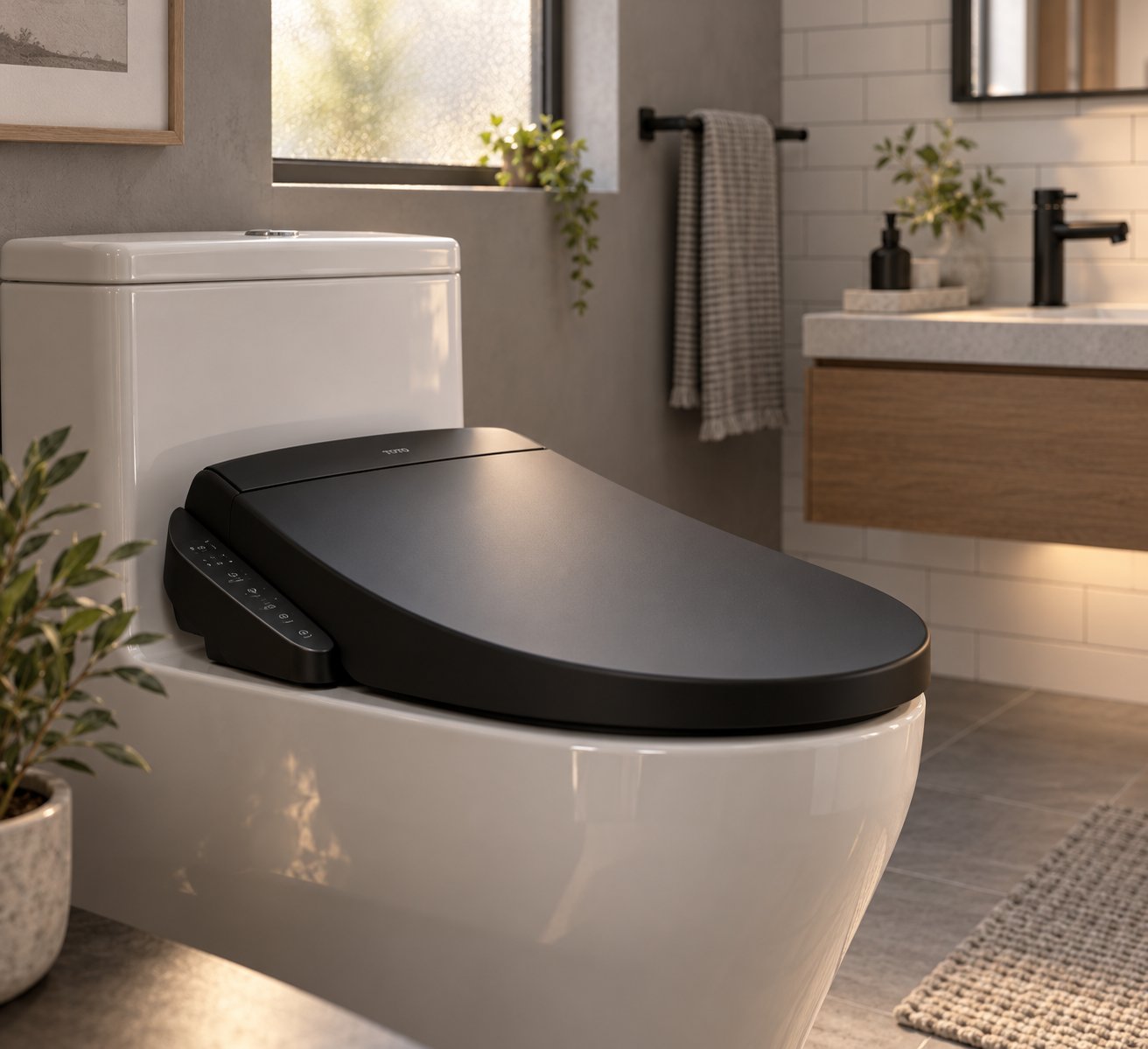
What Is a Black Bidet Toilet Seat and Why It Deserves a Closer Look
A bidet toilet seat black is a toilet seat with built-in bidet wash functionality manufactured in a black housing finish instead of the standard white. It replaces your existing toilet seat, mounts directly onto your current toilet bowl, and delivers features like warm-water cleansing, heated seating, and air drying - all wrapped in a dark, design-forward exterior. Think of it as the point where bathroom technology meets interior design, and you will start to understand why this product category is generating so much quiet interest among homeowners and designers alike.
Yet here is the problem: try searching for honest, educational information about these seats, and you will hit a wall of Amazon listings, Kohler product pages, and TOTO brand catalogs. Every result is trying to sell you something. Nobody is explaining what you actually need to know before spending several hundred dollars on a color-specific bathroom fixture. This article changes that. It is the first brand-neutral, editorially independent guide built entirely around helping you make a smarter decision about black bidet toilet seats.
What Exactly Is a Black Bidet Toilet Seat
If you have never encountered bidet toilet seats before, the category can feel confusing. Three distinct products use the word "bidet," and they are not interchangeable.
- Standalone bidet fixture: A separate porcelain basin installed next to the toilet, common in European and South American bathrooms. It requires its own plumbing lines and floor space.
- Basic bidet attachment: A slim device that clips under your existing toilet seat and connects to the water supply line. It typically offers cold-water spray only, with no electronics, no heated seat, and no black toilet lid option.
- Bidet toilet seat: A full replacement seat that mounts onto your existing toilet bowl and houses electronic components - water heaters, nozzle motors, control boards, and sometimes air dryers. This is the product category we are discussing, and it is the one that comes in a black finish option.
An important distinction worth clarifying early: "black" refers to the seat housing color, not the toilet bowl beneath it. Your toilet bowl remains whatever color it already is - almost always white ceramic. The bidet seat sits on top, so you can retrofit most standard toilets with a black seat to create a striking contrast. Whether you have an elongated bowl or need a round bidet seat, the retrofit process is the same. You remove the old seat, mount the new bracket, and connect water and power.
Why an Informational Guide Matters for This Product
Imagine you are shopping for a Kohler WC seat or browsing TOTO's lineup, and you want it in black. You filter by color and get a handful of results - product specs, pricing, and an "add to cart" button. What you do not get is context. Nobody tells you that the matte black finish you saw on Instagram behaves differently than a glossy black under bathroom lighting. Nobody warns you that the feature set available in black may be narrower than what ships in white. And nobody explains whether your toilet bowl shape even supports the model you are eyeing.
Black bidet toilet seats remain a niche category with limited selection compared to white, making informed research essential before purchasing.
That gap between what shoppers need to know and what the current search results actually deliver is exactly why this guide exists. Every section ahead tackles a specific knowledge gap - from finish types and feature availability to installation requirements and long-term maintenance - so you can approach this purchase with clarity rather than guesswork. The aesthetic payoff of a black seat is real, but only if you get the details right first.
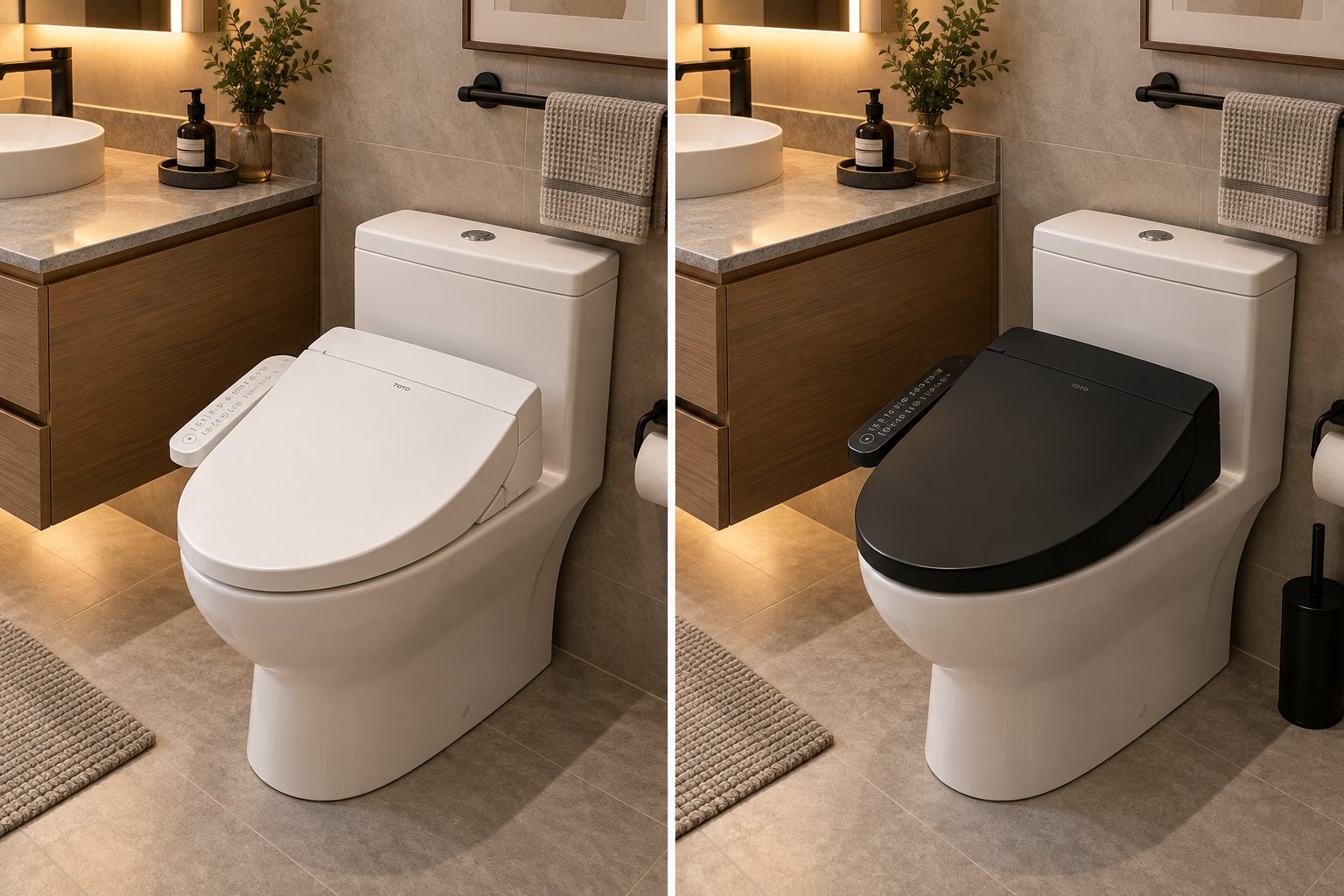
Why Choose a Black Bidet Toilet Seat Over White
Walk into any recently renovated bathroom and you will likely spot it: matte black faucets, black showerheads, dark towel bars, and cabinet pulls that look like they belong in an architectural magazine. Dark fixtures have moved well past trend status and into mainstream design vocabulary. A black bidet seat is the logical extension of that aesthetic - the one fixture that, until recently, was stuck in default white while everything else around it went dark.
The real question most buyers wrestle with is not whether black looks good. It does. The question is whether it makes practical sense for their specific bathroom. And that is a comparison nobody else is making honestly.
Modern Bathroom Design Trends Favoring Dark Fixtures
Picture a bathroom with white subway tile walls, a white porcelain bowl, and a sleek black seat perched on top. That contrast is intentional, and it is one of the strongest visual tools in contemporary bathroom design. Interior designers describe this as "visual weight" - the dark seat anchors the eye, giving the toilet a presence it simply does not have in all-white configurations.
Black works across several popular design schemes. In monochromatic bathrooms, where charcoal walls meet dark slate flooring, a black bidet seat disappears into the palette and feels cohesive. In industrial-style spaces with exposed concrete and matte metal, it reads as purposeful hardware rather than a plastic accessory. And in minimalist powder rooms, where every object is a deliberate choice, a dark seat against white ceramic creates the kind of high-contrast pairing that design experts at Homes & Gardens note can make even compact spaces feel intentional and impactful.
You might assume black only suits large master bathrooms with plenty of natural light. In reality, small powder rooms benefit just as much - sometimes more. A dark seat in a tight space creates a focal point that draws the eye downward and gives the room a sense of grounded sophistication. The same design logic that makes dark wall colors work in small rooms applies here: dark surfaces recede and blur boundaries rather than shrinking a space.
This trend also explains why brands like Kohler now include black options across their toilet seats lineup, and why an American Standard toilet seat in dark finishes has become easier to find than it was even a few years ago. The market is responding to real demand, not just designer whims.
Practical Trade-Offs Between Black and White Bidet Seats
Aesthetic appeal only tells half the story. Choosing between a black and white bidet seat involves trade-offs that affect your daily experience, your feature options, and potentially your home's resale appeal. Here is an honest breakdown.
Pros of a Black Bidet Seat
- Aesthetic coordination: Matches the matte black hardware trend that dominates modern bathroom design, creating a unified look from faucet to fixture.
- Hides certain stains: Discoloration from mineral deposits or everyday use is less immediately visible on dark surfaces than on white.
- Modern visual appeal: Delivers a bold, design-forward statement that elevates the bathroom beyond the standard builder-grade look.
Cons of a Black Bidet Seat
- Far fewer models available: The selection of black options is a fraction of what ships in white, which limits your feature choices significantly.
- Dust and water spots show more: Much like dark leather seats in a car, black surfaces reveal dried water droplets, dust, and cleaning product residue more readily than light ones.
- Potential resale-value concerns: Future buyers who prefer neutral white may view a black seat as a taste-specific choice that needs replacing.
Pros of a White Bidet Seat
- Widest feature selection: Virtually every manufacturer releases their full technology lineup in white first, giving you the broadest range of advanced features.
- Universal look: White matches any bathroom style and any existing toilet bowl without creating a visual mismatch.
- Easier to spot cleanliness: You can see at a glance whether the seat surface needs attention, which some users find reassuring from a hygiene standpoint.
Cons of a White Bidet Seat
- Can yellow over time: Prolonged exposure to bathroom humidity, cleaning chemicals, and UV light can cause white plastic housings to develop a yellowish tint.
- Shows certain stains more readily: Discoloration, waterline marks, and everyday wear are immediately obvious on bright white surfaces.
Here is the critical takeaway that gets overlooked: the choice between black and white is primarily aesthetic, but feature parity between the two colors is not guaranteed. Many advanced Kohler toilet seats and competing models ship their top-tier technology exclusively in white housings. If you have your heart set on a specific feature - say, an oscillating nozzle with a built-in deodorizer - you may find it simply is not available in black yet. That reality makes it essential to decide on your must-have features first and then check whether they come in your preferred color, rather than the other way around.
The finish itself introduces another layer of complexity. A matte black seat paired with glossy black faucets - or vice versa - creates a subtle visual mismatch that can undermine the coordinated look you are aiming for. And that finish question turns out to be far more nuanced than most buyers expect.
Matte Black vs Glossy Black vs Honed Black Finish Differences
That subtle visual mismatch between a matte faucet and a glossy seat? It happens more often than you would think - and it happens because most buyers treat "black" as a single, universal color. It is not. When you shop for a bidet toilet seat black, you are actually choosing from up to three distinct finish categories, and each one behaves differently under bathroom lighting, responds differently to cleaning, and ages differently over the years. Understanding these differences before you buy is the kind of detail that separates a bathroom that looks professionally designed from one that feels slightly off.
Matte Black Finishes and Their Cleaning Characteristics
Matte black is the finish you see most often in contemporary bathroom design, and for good reason. It delivers a smooth, non-reflective surface with a soft visual texture that feels modern and understated. If you have matte black faucets or towel bars already installed, a matte toilet seat bidet will blend right in without competing for attention.
One of the biggest practical advantages? Fingerprint resistance. Matte surfaces hide fingerprints, water spots, and smudges far better than their glossy counterparts, which means you will not see every touch and splash the moment you walk into the bathroom. For a fixture that gets handled multiple times a day, that matters more than most people realize.
The trade-off is cleaning. Matte finishes can be slightly more difficult to wipe clean of soap residue and mineral deposits compared to gloss. The non-reflective texture that hides fingerprints also gives soap scum and hard-water film something to cling to. You will want to use a soft microfiber cloth and a mild, non-abrasive cleaner - never bleach, acetone, or ammonia-based products, which can dull or permanently damage the finish on ABS plastic housings. A gentle weekly wipe-down keeps matte surfaces looking factory-fresh without much effort.
Glossy and Honed Black Finish Comparisons
Glossy black is the opposite end of the spectrum - a high-shine, reflective surface that catches light and creates a polished, almost lacquer-like appearance. Imagine a piano-black finish on a piece of electronics, and you have the right mental image. The upside is that glossy surfaces wipe clean easily. A damp cloth removes dust, soap residue, and grime in a single pass because there is no texture for particles to grip.
The downside is visibility. Every fingerprint, every dried water droplet, every speck of dust shows up immediately on a glossy black seat. You will find yourself cleaning more frequently - not because the seat is dirtier, but because the finish broadcasts every imperfection. If your bathroom has hard water, expect to see mineral spots forming within hours of the last cleaning.
Then there is the third option that fewer buyers know about: honed black. This is a term you will encounter in product filters from brands like Kohler - a lightly polished, stone-like finish that splits the difference between matte and gloss. Honed surfaces have a soft sheen without full reflectivity. They resist fingerprints better than glossy finishes while being somewhat easier to clean than full matte. Think of it as the middle ground for buyers who want a hint of visual depth without the maintenance demands of high gloss.
Not every manufacturer offers all three options. If you are browsing Kohler bidet toilet seat models, you may find honed black listed alongside matte and gloss. Browse american standard toilets seats, and the finish options could be entirely different - or limited to a single finish in black. Availability is manufacturer-dependent, and it shifts as product lines are updated.
| Criteria | Matte Black | Glossy Black | Honed Black |
|---|---|---|---|
| Fingerprint Visibility | Low - texture masks oils and prints | High - every touch is immediately visible | Moderate - soft sheen reduces but does not eliminate prints |
| Water-Spot Visibility | Low to moderate - spots blend into the surface | High - dried droplets are very obvious | Moderate - less visible than gloss, slightly more than matte |
| Ease of Cleaning | Moderate - soap residue can cling to texture | High - smooth surface wipes clean quickly | Moderate to high - easier than matte, close to gloss |
| Scratch Resistance | Moderate - micro-scratches less visible but can occur | Low to moderate - scratches show prominently on reflective surface | Moderate - light polish helps mask minor abrasions |
| Overall Aesthetic Character | Modern, understated, pairs with industrial and minimalist styles | Bold, luxurious, creates a high-contrast focal point | Refined, versatile, bridges contemporary and transitional design |
Here is the advice that can save you from a frustrating mismatch: confirm the exact finish type before purchasing. Product photos on retail websites are notoriously unreliable for distinguishing matte from honed from glossy. Screen calibration, studio lighting, and post-production editing all shift how a finish appears in images. A seat that looks perfectly matte on your laptop may arrive with a noticeable sheen - or vice versa. Whenever possible, read the product description for explicit finish terminology, check customer review photos taken under real bathroom lighting, and contact the manufacturer directly if the listing is ambiguous. Toilet seats for american standard toilets, Kohler models, and other brands each use their own naming conventions for finishes, so do not assume that "black" means the same surface treatment across different product lines.
Getting the finish right matters because it affects everything you see and touch daily - from how the seat looks under your vanity lights to how often you reach for a cleaning cloth. And that daily interaction raises an equally important question: do the features inside the seat match what you actually need? Because as it turns out, the technology packed beneath that black housing varies dramatically depending on the model - and not every feature is available in every color.
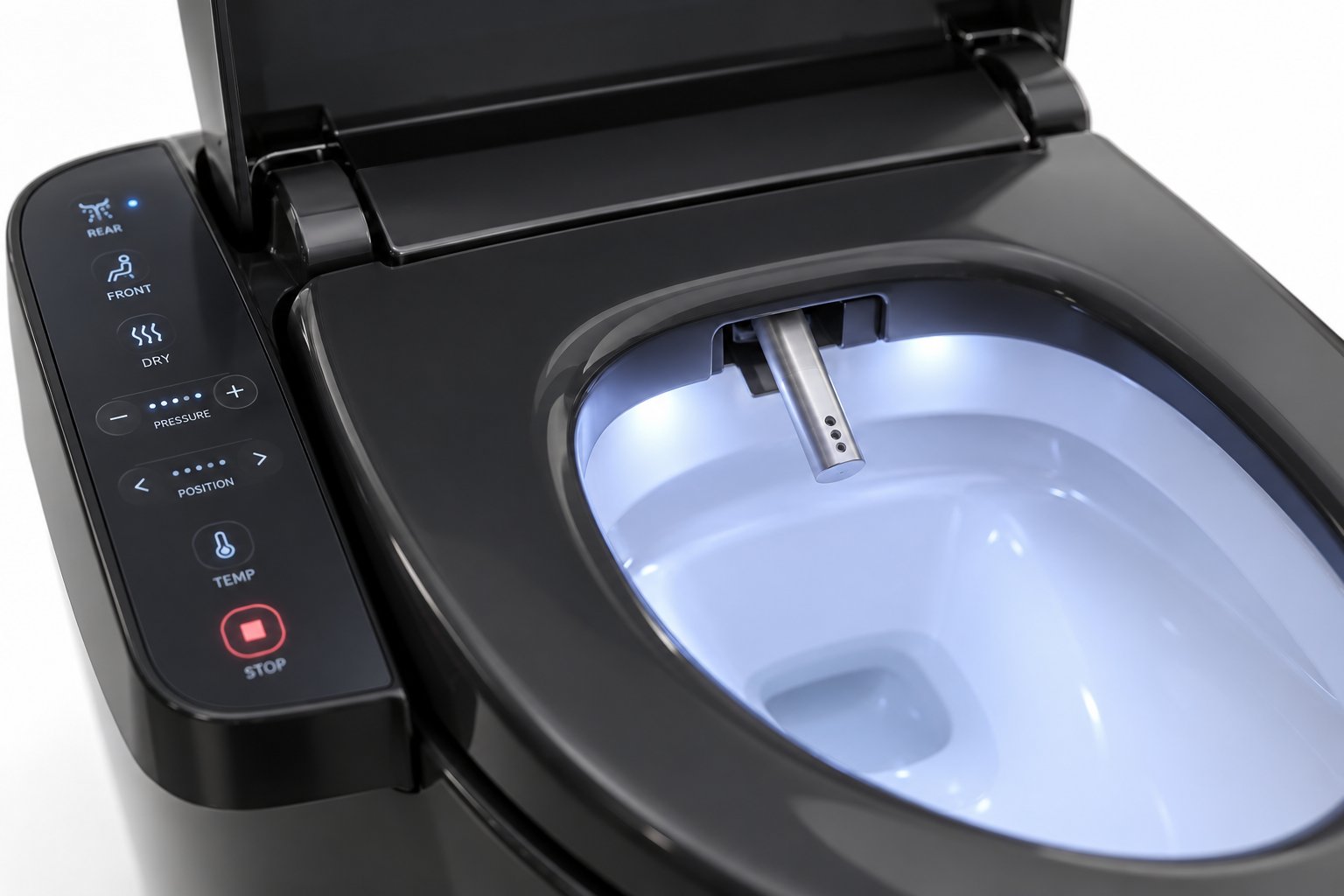
Key Bidet Toilet Seat Features and Technologies Explained
You have picked the perfect finish. You know whether you want matte, glossy, or honed. But here is where things get interesting - and where many buyers stumble. The technology packed inside a bidet toilet seat is what transforms it from a stylish bathroom accessory into something you genuinely rely on every single day. And the gap between what is technically possible and what is actually available in a black housing is wider than most people expect.
Let's break down the features in plain language so you know exactly what each one does, how it feels in daily use, and whether you can realistically get it in the color you want.
Heated Seats, Warm Water Wash, and Air Dryers Explained
These are the three headline features that convince most people to upgrade from a standard toilet seat to a bidet seat. They are also the ones that generate the most questions from first-time buyers.
Heated seat surfaces. Imagine walking into a cold bathroom at 6 a.m. and sitting down on a seat that is already warm. That is exactly what a heated bidet seat delivers. Most models offer adjustable temperature settings - typically three to five levels - so you can dial in anything from a subtle warmth to a noticeably cozy surface. The heating element sits inside the seat housing and warms the contact area on demand. Some seats include an energy-saving mode that reduces heating during hours when the bathroom is not in use, then warms back up based on a schedule or a built-in occupancy sensor.
Warm-water wash. This is the core bidet function, and it is the feature that replaces (or dramatically reduces) your reliance on toilet paper. When activated, a retractable nozzle extends from beneath the seat and delivers a stream of warm water for personal cleansing. The water does not come from the toilet bowl - it draws directly from your household fresh-water supply through a dedicated connection line. Inside the seat, an integrated water heater brings that cold supply up to a comfortable temperature before it reaches your skin.
Two heating systems dominate the market. Tank-based heaters store a small reservoir of pre-warmed water, which works well for shorter wash cycles but can run cool if you prefer a longer cleanse. Instant (tankless) heaters warm water continuously as it flows, providing an essentially endless supply of warm water at a consistent temperature. If warm-water performance matters to you - and for most users, it is the single most important comfort feature - a tankless system is worth seeking out. The American Standard bidet lineup and comparable models from other major brands increasingly use instant heating in their mid-tier and premium seats.
Warm-air dryers. After the water wash, a built-in fan draws in room air, passes it over a small heating element, and directs a gentle warm breeze across the cleansed area. Sounds complex? It is actually straightforward - think of a compact, low-powered hair dryer aimed exactly where you need it. The practical result is a significant reduction in toilet paper use. Most users find that the dryer handles the bulk of drying, with perhaps a square or two of paper for a final pat if desired. Drying cycles typically last one to two minutes, and temperature is usually adjustable across two to four levels.
Together, these three features create a daily experience that feels genuinely different from a standard toilet. You sit down on a warm surface, cleanse with temperature-controlled water, and dry with warm air - all without reaching for a roll of paper. It is the kind of upgrade that seems excessive until you try it, and then going back to a cold, paper-only routine feels like a downgrade.
Advanced Technologies Like Deodorizers, Night Lights, and Oscillating Nozzles
Beyond the core trio, bidet toilet seats can pack a surprising amount of secondary technology into that compact housing. These features vary widely across price tiers and brands, but understanding them helps you evaluate whether a particular model justifies its price tag.
Deodorizers. Nobody talks about bathroom odor in polite conversation, but a catalytic or activated-carbon deodorizer quietly solves the problem. These systems draw air from the bowl area through a filter that neutralizes odors before they reach the rest of the room. Higher-end seats use catalytic deodorizers that break down odor molecules, while more affordable models rely on replaceable carbon filters. Either way, the result is a bathroom that smells noticeably fresher - especially in small powder rooms with limited ventilation.
LED night lights. A soft glow illuminating the bowl might sound like a gimmick until you stumble into a dark bathroom at 2 a.m. Night lights built into bidet seats cast just enough light to navigate without flipping on the overhead fixture and jolting yourself fully awake. Most models offer multiple color options or a subtle white glow, and the light activates automatically via a motion sensor or occupancy detection.
Oscillating and pulsating nozzle patterns. Standard bidet wash delivers a fixed stream to one position. Oscillating mode moves the nozzle slowly back and forth during the wash cycle, spreading water across a wider area for more thorough cleansing. Pulsating mode rapidly varies the water pressure in a rhythmic pattern, creating a gentle massaging sensation. Both features are controlled through a remote or side panel, and many users find that oscillating wash, in particular, provides a noticeably more comfortable and effective clean than a static spray.
You will also encounter brand-specific terminology that can be confusing without context. TOTO's PREMIST feature pre-mists the inside of the toilet bowl with a light spray of water before use, creating a slick surface that helps prevent waste from adhering to the ceramic - which means less scrubbing later. Their EWATER+ system uses electrolyzed water to automatically rinse and sanitize the nozzle after each use, adding a layer of hands-free hygiene. Kohler's PureWash product line bundles multiple comfort features - heated seat, adjustable wash, dryer, and stainless-steel nozzle - into a single bidet seat package designed to retrofit onto existing toilets. These are not fundamentally different technologies; they are branded implementations of the same core concepts.
For buyers considering round bidet toilet seats specifically, it is worth noting that advanced features like oscillating wash and deodorizers tend to appear more consistently in elongated models. Round models exist, but the smaller housing footprint can limit which secondary features manufacturers include, especially in budget and mid-tier price ranges. If you need a round bidet toilet seat with a full feature set, expect to shop more carefully and potentially pay a premium for the combination.
Feature Availability in Black vs White Models
Here is the reality that no product listing spells out for you: most manufacturers develop and debut their full feature sets in white housings first. Black versions, when they exist, often arrive later in the product cycle and may represent a narrower slice of the feature range. This is not a manufacturing limitation so much as a market-size calculation - white outsells black by a wide margin, so brands invest their engineering and tooling resources in white models first and extend to black selectively.
What does that mean in practice? It means the flagship bidet seat from a given brand - the one with the tankless heater, the oscillating nozzle, the deodorizer, the night light, and the self-cleaning wand - might only ship in white. The black option from the same brand could be a tier down: heated seat and warm water, yes, but perhaps no dryer, no deodorizer, or a tank-based heater instead of tankless. You might find a comparable American Standard commode seat or a competing model that checks your feature boxes in black, but you will need to verify each specification individually rather than assuming color variants are identical twins.
This gap is not universal. Some manufacturers do offer feature parity across colors, and the selection of fully loaded black models is gradually expanding. But "gradually" is the key word. At any given moment, the black catalog is thinner than the white one.
The feature you want and the color you want may not always come in the same package - verify before you buy.
The practical takeaway is simple: build your shopping list around features first. Decide which technologies are non-negotiable - warm water, heated seat, dryer, deodorizer, oscillating nozzle - and which are nice-to-haves. Then filter by black and see what matches. If your must-have feature only ships in white, you have a decision to make: compromise on color or compromise on function. Neither answer is wrong, but making that choice deliberately is far better than discovering the mismatch after the box is already open.
Features and finish are two critical pieces of the puzzle, but there is a third variable that can override both of them entirely - and it has nothing to do with technology or aesthetics. It is the physical shape of the toilet bowl sitting in your bathroom right now.
Elongated vs Round Toilet Seat Compatibility for Bidet Seats
That third variable? It is the shape of your toilet bowl - and getting it wrong is one of the most common (and most frustrating) return reasons in the entire bidet seat category. An elongated seat on a round bowl hangs awkwardly over the front rim. A round seat on an elongated bowl leaves a crescent of exposed ceramic that looks unfinished and feels unstable. Neither situation is fixable without ordering a different seat entirely. Before you evaluate features, finishes, or color options, this one measurement has to come first.
Elongated vs Round Front Toilet Bowls and How to Measure
North American toilets come in two standard bowl shapes, and the difference boils down to roughly two inches.
Elongated bowls measure approximately 18.5 inches from the center of the seat mounting bolt holes to the front edge of the bowl rim. They have an oval shape that is noticeably longer from back to front. Round front bowls measure approximately 16.5 inches using the same reference points. From above, a round bowl looks close to a circle, while an elongated bowl stretches into an obvious oval.
Measuring takes about sixty seconds. Grab a tape measure, lift the seat and lid out of the way, and find the two bolt holes at the back of the bowl where the seat attaches. Measure from the midpoint between those bolts straight forward to the outside front edge of the rim. That single number - roughly 16.5 or 18.5 inches - tells you exactly which seat shape your toilet requires. The bolt holes themselves should sit about 5.5 inches apart, which is standard across both shapes.
If your measurement lands somewhere in between - say, around 17.5 inches - you may have a compact elongated bowl. These toilets occupy the footprint of a round model but typically require an elongated seat. Check the manufacturer's spec sheet using the model number stamped inside the tank or on its underside before ordering. Whether you are shopping for a toilet seat for American Standard models, Kohler fixtures, or any other brand, this measurement is the non-negotiable starting point.
Which Bowl Shape Offers More Black Bidet Seat Options
Elongated bowls dominate modern bathroom installations, and manufacturers have followed that demand. The vast majority of bidet seats - including those offered in black - are designed for elongated toilets first. American Standard toilet seats, Kohler bidet toilet seats, and most competing lines release elongated versions as the default, with round versions arriving as secondary options or, in some cases, not at all.
For black specifically, the selection narrows even further. If you have a round bowl and want a black bidet seat, you are filtering an already limited color catalog by the less common shape. The options exist, but expect fewer models, fewer feature tiers, and potentially longer lead times. An American Standard bidet toilet seat in black and round, for instance, may simply not be in the current lineup when you search.
Here are practical steps to avoid a costly mismatch:
- Measure before shopping. Do not guess based on how the bowl looks - verify with a tape measure using the bolt-to-rim method described above.
- Check product listings for explicit shape specification. Look for the words "elongated" or "round front" in the product title or specs, not just in a dropdown filter that could default to the wrong option.
- Verify whether a manufacturer offers the same model in both shapes. Some brands produce a given bidet seat in elongated only, even if their standard toilet seats come in both configurations.
- Be cautious with "universal-fit" claims. Some seats advertise compatibility with both bowl shapes, but universal designs often compromise fit quality - slight overhang on round bowls or a loose feel on elongated ones.
Shape compatibility is binary: it either fits or it does not. No amount of adjusting, shimming, or creative installation changes a mismatch into a proper fit. Confirm the shape, then move on to evaluating color, finish, and features - in that order.
Of course, even a perfectly shaped seat still needs two things your bathroom may or may not have ready: a power source and a water connection. And the electrical question, in particular, catches more first-time bidet buyers off guard than almost anything else.
Do Bidet Seats Need Power and Other Installation Essentials
You have measured your bowl, chosen your finish, and narrowed down your feature list. The box arrives, you clear your Saturday morning, and then you glance behind your toilet and realize - there is no electrical outlet within reach. This single oversight derails more bidet seat installations than any other issue, and it is the one detail that separates a smooth weekend project from an unexpected call to an electrician.
So do bidets need power? The short answer: it depends entirely on the type. But if you are shopping for a full-featured bidet toilet seat black - one with a heated seat, warm water wash, air dryer, or deodorizer - the answer is yes, it needs a dedicated power source.
Electrical Requirements for Bidet Toilet Seats
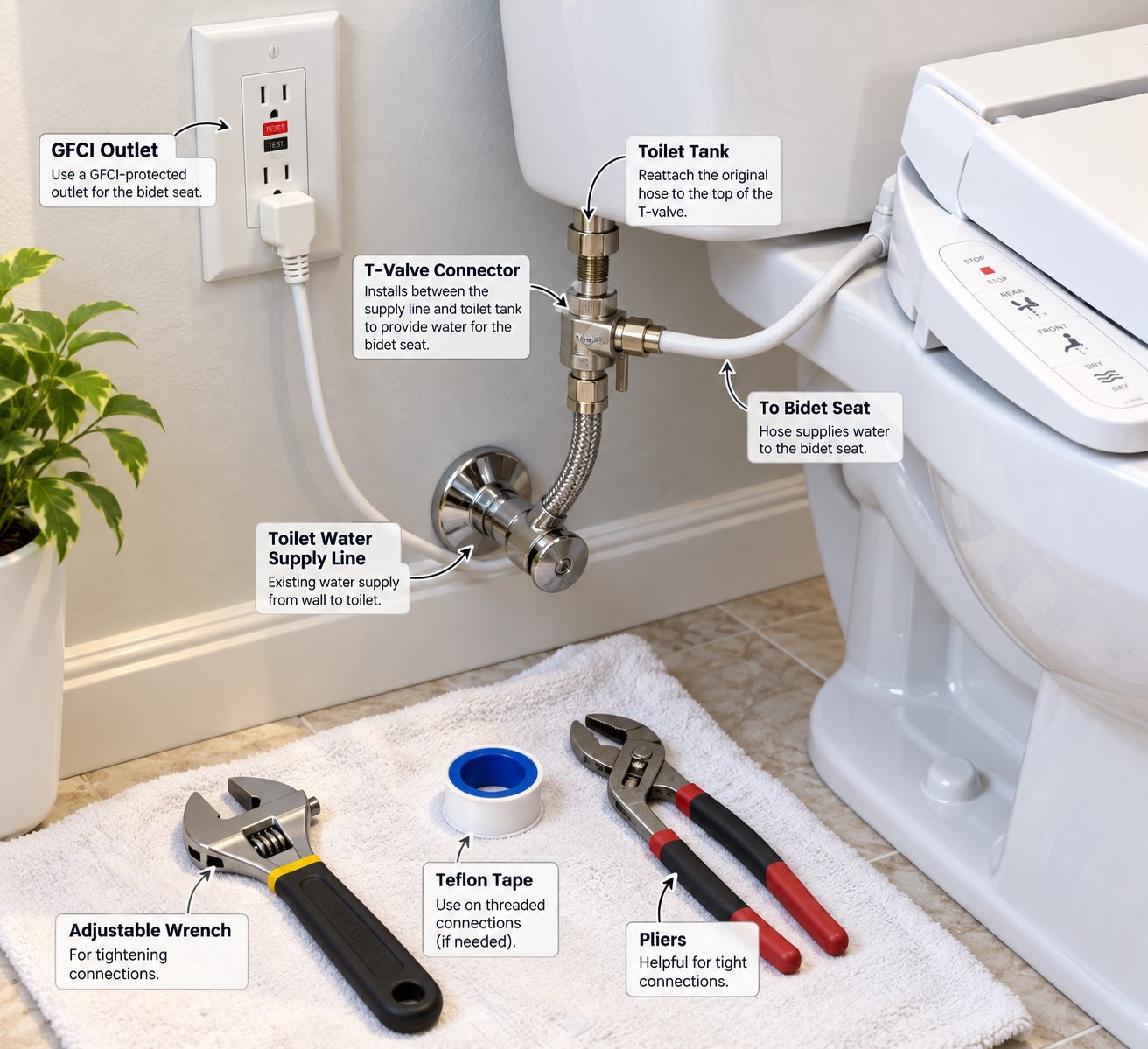
Every bidet seat that offers heated water, a warm seat surface, an air dryer, or electronic controls requires electricity to operate. In North America, that means a standard 120V GFCI-protected electrical outlet within cord reach of the toilet - typically three to four feet. GFCI stands for Ground Fault Circuit Interrupter, and it is the outlet type with the small "test" and "reset" buttons on its face. Building codes require GFCI protection for all bathroom outlets because water and electricity share close quarters in these spaces.
Here is where things get tricky: many bathrooms, especially in older homes, do not have an outlet near the toilet. You might have one by the vanity mirror or near the sink, but that could be six or eight feet away - well beyond the reach of a standard bidet seat power cord. Running an extension cord across the bathroom floor is not just unsightly; it is a genuine safety hazard in a wet environment and violates electrical codes.
If your bathroom lacks a nearby outlet, adding one typically requires a licensed electrician. The job involves running new wiring from the existing bathroom circuit (or adding a dedicated circuit) and installing a GFCI-protected receptacle in an accessible location near the toilet. Electrical code requires that GFCI outlets be placed in easy-to-reach areas and not blocked by fixtures, so the electrician will need to position it close to the toilet without putting it directly behind the tank where you cannot access the test and reset buttons. Expect this to cost anywhere from $150 to $400 depending on your home's wiring and local labor rates.
What if you want to skip the electrical requirement entirely? Non-electric bidet attachments and basic round bidet models connect only to the toilet's water supply and offer a cold-water wash without any power-dependent features. They are simpler, cheaper, and require no outlet at all. The trade-off is significant, though - you give up heated water, warm seat surfaces, air drying, deodorizers, night lights, and electronic nozzle controls. For many buyers, those are the very features that justify the upgrade to a full bidet seat in the first place. An american bidet attachment without power is a perfectly functional hygiene tool, but it is a fundamentally different product category than the feature-rich toilet black seat you may be envisioning.
If you already have a GFCI outlet near your toilet, you are ahead of the game. Verify its location, confirm that the cord from your chosen bidet seat can reach it, and move on to the plumbing side of the installation.
Water Supply Connections and Mounting Basics
The good news? The plumbing and mounting portion of a bidet seat installation is genuinely homeowner-friendly. You do not need professional plumbing skills, specialized tools, or prior experience. Most people complete the entire process in thirty to sixty minutes using only a wrench, a towel, and the hardware included in the box.
Here is the standard installation sequence:
- Turn off the water supply. Locate the shut-off valve on the wall or floor behind your toilet and close it completely. Flush the toilet to empty the tank, and have a towel or small bucket ready to catch any residual water.
- Remove the existing toilet seat. Unscrew the mounting bolts at the back of the bowl - the same bolt holes you measured from when checking your bowl shape. Lift off the old seat and clean the rim thoroughly.
- Attach the bidet seat mounting plate. Align the included bracket (sometimes called a catch plate) over the bolt holes and secure it with the provided hardware. This plate is what the bidet seat clicks onto.
- Install the T-valve on the water supply line. Disconnect the flexible water supply hose from the base of the toilet tank. Attach the T-valve (included with most bidet seats) to the tank inlet, then reconnect the supply hose to the bottom port of the T-valve. Connect the bidet's own supply hose to the upper port.
- Mount the bidet seat onto the bracket. Slide the seat onto the mounting plate until it clicks into position. Most seats have a quick-release button so you can remove and reattach the seat easily for cleaning.
- Connect the bidet supply hose. Attach the free end of the bidet hose to the seat's water inlet. Hand-tighten, then snug slightly with a wrench - overtightening can crack plastic fittings.
- Plug in the power cord and turn on the water. Open the shut-off valve, check every connection point for leaks, and power on the seat to test its functions.
That is the entire process. If you have ever replaced a standard toilet seat or swapped out a kitchen faucet supply line, the plumbing portion will feel familiar. The T-valve is the only new component for most people, and it simply splits one water line into two - one feeding the toilet tank as usual, and one feeding the bidet seat.
A bidet for Kohler toilet models, American Standard fixtures, and most other standard-mount toilets all follow this identical procedure. The brand name on your existing toilet does not change the installation steps. And here is the reassurance worth repeating: black bidet seats install exactly the same way as white ones. The color of the housing has zero effect on plumbing connections, electrical requirements, T-valve compatibility, or mounting hardware. If a bidet for Kohler toilet bowls installs a certain way in white, the black version of that same model uses the same bracket, the same valve, and the same power cord.
The only part of this process that should involve a professional is the electrical work, and only if your bathroom needs a new outlet. Everything else is a straightforward DIY project that rewards a careful read of the included instructions and about an hour of unhurried effort.
A perfectly installed bidet seat means nothing if the model you ordered does not match your bathroom's shape, features, or finish - and those shopping mistakes are far more common than installation errors.
Common Mistakes When Shopping for Black Bidet Toilet Seats
Installation is the easy part. Seriously. A wrench, an hour, and a YouTube video can get most people through the plumbing and mounting without a hitch. The mistakes that actually cost you money - and weeks of frustration waiting for return shipping - happen long before the box arrives at your door. They happen during the shopping process itself, when assumptions fill in the gaps that product listings leave wide open.
Black bidet toilet seats attract a specific kind of buyer: someone who cares about both function and design, who has already invested in coordinated dark fixtures, and who expects a premium result. That combination of high expectations and limited product selection creates a perfect setup for avoidable errors. Here are the ones that trip people up most often - and how to sidestep every single one.
Assuming All Features Are Available in Black
This is the mistake that stings the most because it feels so unfair. You spend an hour researching the perfect bidet seat for toilet use - tankless heater, oscillating nozzle, deodorizer, air dryer, the works - and then you go to select your color. Black is not an option. Or worse, black is listed, but when you compare the spec sheets side by side, the black model ships with a tank-based heater instead of tankless, or it drops the deodorizer entirely.
Why does this happen? Manufacturers make business decisions based on volume. White outsells black by a wide margin, so the full R&D investment - every sensor, every motor configuration, every premium component - goes into white housings first. Black variants, when they appear, often represent the mid-tier or entry-level feature set. You might find a Kohler black toilet seat with heated water and a warm seat, but the same brand's flagship model with every bell and whistle? White only.
The fix is a simple change in your shopping sequence. Instead of filtering by "black" and browsing what shows up, start by listing your non-negotiable features. Heated seat, warm water, dryer, specific nozzle functions - write them down. Then check which models offer that exact feature combination. Only after you have a shortlist of functionally acceptable seats should you filter by color. This approach prevents you from falling in love with a feature set that does not exist in the finish you want, and it forces you to make any trade-offs deliberately rather than discovering them after unboxing.
Overlooking Finish Type and Bowl Shape Mismatches
Imagine you have spent months pulling together a cohesive bathroom design: matte black faucet, matte black towel bar, matte black showerhead. Everything coordinates beautifully. Then your bidet seat arrives, and it is glossy. Not dramatically glossy, but enough that under your vanity lighting, it catches reflections while everything else absorbs them. The visual dissonance is subtle but persistent - the kind of detail that bothers you a little more every time you walk into the room.
This mismatch happens because most product listings describe the color as simply "black" without specifying whether the finish is matte, glossy, or honed. As USA Builders Depot notes, two products described as matte black may differ in tone, texture, and sheen, especially when placed side by side. If the listing does not explicitly state the finish type, do not assume it matches your existing hardware. Contact the manufacturer, check customer review photos taken under real bathroom lighting, or order a sample if one is available.
The bowl-shape mismatch is even more straightforward - and even more common. Ordering an elongated bidet seat for a round bowl remains one of the most frequent return reasons in the bidet seat category. Buyers get excited about finding their preferred color and features, rush through checkout, and skip the shape verification step entirely. The seat arrives, hangs two inches past the front rim, and back it goes. With black options already scarce, a return means starting the search over from scratch - possibly with restocking fees attached. Measure first, every time, no exceptions.
Ignoring Warranty and Long-Term Durability Signals
A bidet seat is not a passive slab of plastic. Inside that sleek housing sits a collection of electronic components - heating elements, water pumps, motorized nozzles, circuit boards, and sensors - all operating in the most moisture-rich room of your home. Components fail. It is not a question of if, but when and how well you are protected when it happens.
Warranty length is one of the clearest signals of manufacturer confidence. A brand offering a three-year warranty on electronics and mechanical parts is telling you something different than one offering ninety days. For black kohler toilets and comparable premium lines, warranties typically fall in the one-to-three-year range for electronic components, with the seat housing itself sometimes covered longer. Budget models from lesser-known brands may offer minimal coverage - or vague terms that exclude the most failure-prone parts.
Black finishes add a durability dimension that white simply does not have. Dark surfaces show scratches, scuffs, and finish wear more visibly than light ones. The material composition of the housing matters: seats made from high-quality ABS plastic with UV-resistant pigments and scratch-resistant coatings hold their appearance far longer than budget housings using standard pigmentation. American standard replacement toilet seats and other major-brand offerings typically disclose their housing material, while generic listings may not. If the listing does not mention material composition, that silence is worth treating as a yellow flag.
Before you finalize any purchase, run through this quick verification checklist:
- Bowl shape confirmed: You have physically measured from the bolt holes to the front rim and matched the result to the product listing's shape specification.
- Finish type verified: The listing explicitly states matte, glossy, or honed - not just "black" - and you have confirmed it matches your existing fixtures.
- Feature list reviewed line by line: You have compared the black model's spec sheet against the white version of the same seat to identify any feature differences.
- Warranty terms read in full: You know the coverage duration for electronics, mechanical parts, and the seat housing separately, including what voids the warranty.
- Housing material identified: The product discloses whether the seat is ABS plastic, polypropylene, or another material, and whether the finish includes UV or scratch resistance.
- Return policy understood: You know the window for returns, whether restocking fees apply, and who covers return shipping if the seat does not fit or meet expectations.
Every item on that list takes minutes to verify. Skipping even one of them can cost you weeks of hassle and hundreds of dollars. Shopping for black kohler toilets, budget imports, or anything in between - the checklist is the same. The brands that make verification easy are generally the ones confident enough in their product to welcome the scrutiny.
Getting the purchase right is only half the equation, though. A black bidet seat that looks perfect on installation day still needs to look that way six months later - and dark finishes demand a different care routine than the white seats most cleaning guides are written for.
Cleaning, Maintenance, and Long-Term Durability of Black Bidet Seats
A dark finish that looked stunning the day you installed it can start telling a very different story within weeks if you clean it the wrong way - or do not clean it at all. White seats hide dust and dried water droplets remarkably well. Black surfaces do the opposite: every mineral spot, every streak of cleaning product residue, and every thin film of bathroom dust announces itself under even modest lighting. That visibility is not a flaw in the product. It is simply the reality of owning any dark-finished fixture, and it means your care routine needs to be slightly more intentional than what you are used to with standard white seats.
Daily and Weekly Cleaning Best Practices for Black Seats
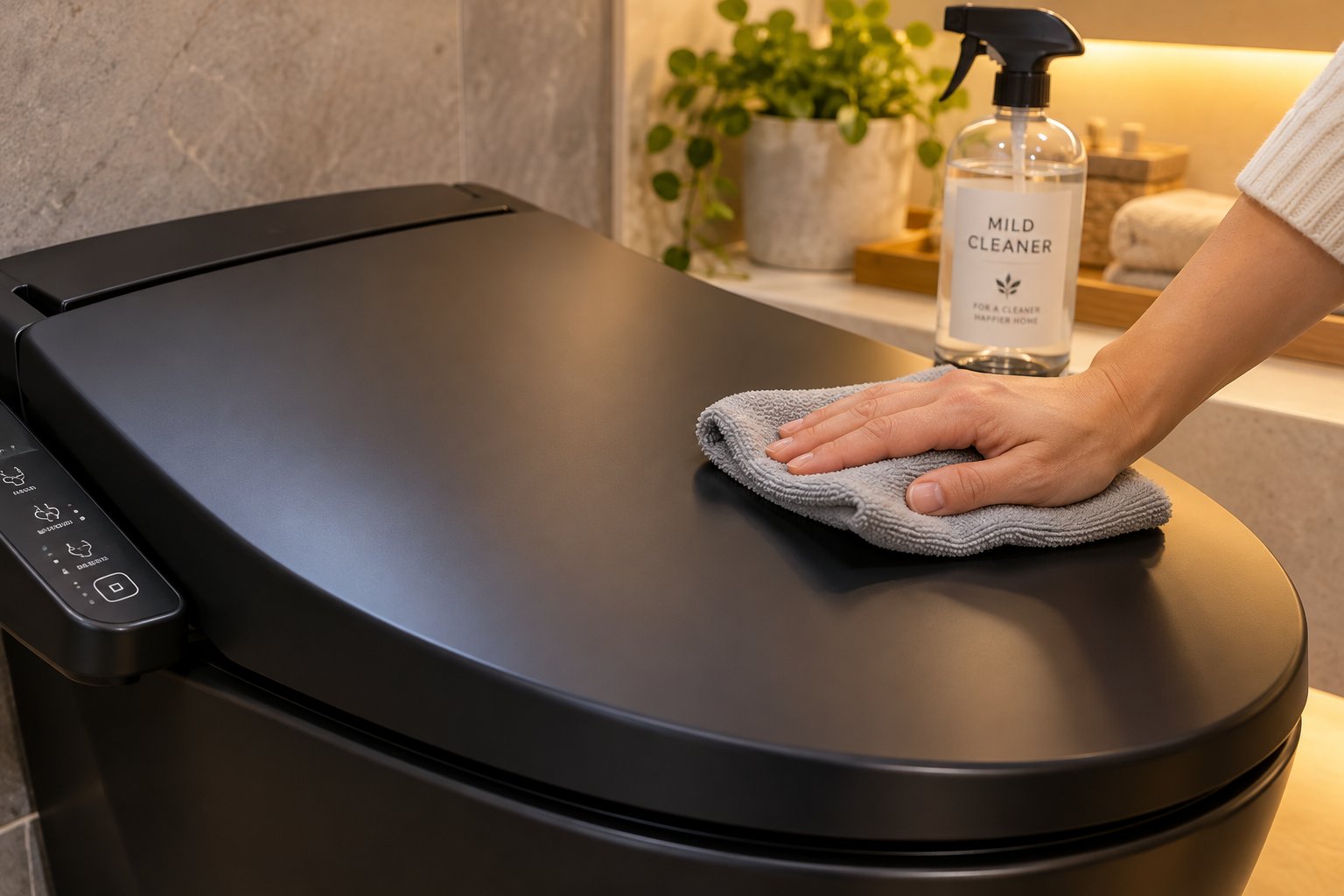
The single best tool for maintaining a black bidet seat is something you probably already own: a soft microfiber cloth. Microfiber picks up dust, water spots, and light residue without scratching the surface - and scratches on a dark finish are far more visible than on a white one. A quick dry wipe after your last bathroom use each evening takes about fifteen seconds and keeps the seat looking clean between deeper sessions.
For your weekly routine, a mild, non-abrasive cleaner paired with that same microfiber cloth handles the heavier work. Products like diluted dish soap or a gentle all-purpose spray work well. Brondell's bidet care guide specifically recommends mild cleaners such as Simple Green or Windex and warns against harsh products like bleach, full-strength vinegar, or anything containing chloride or hydrochloric acid - these can damage metal components and leave unsightly marks on the seat's finish. That warning applies doubly to black surfaces, where chemical dulling or discoloration shows up immediately rather than blending into a light background.
Here is a detail that catches many owners off guard: hard water is a black seat's worst enemy. If your household water has high mineral content, you will notice chalky white spots forming on the seat surface anywhere water splashes and dries. On a white seat, those deposits are nearly invisible. On black, they look like someone sprinkled baby powder across the surface. In hard-water areas, bumping your wipe-down from weekly to every few days makes a noticeable difference. A damp microfiber cloth removes fresh mineral film easily, but deposits that sit and harden require more effort - and more aggressive cleaning products that risk damaging the finish.
A few additional care principles worth keeping in mind:
- Never use abrasive sponges or scrubbing pads. Even "soft scrub" sponges can leave micro-scratches that dull a black surface over time, especially on glossy finishes.
- Avoid bleach-based bathroom cleaners entirely. Pioneer Industries notes that improper cleaning of matte black fixtures can result in permanent damage, including fading and blotches. The same applies to bidet seat housings.
- Keep personal care products away from the seat. Hairsprays, lotions, and body oils that land on a heated bidet seat can leave stains that are difficult to remove once the surface warms and the residue bonds to the plastic.
- Unplug the seat before any wet cleaning. This is a safety requirement, not a suggestion - you are working with water near electronic components.
Nozzle maintenance follows the same schedule regardless of whether your elongated bidet toilet seat is black, white, or any other color. Most modern seats feature self-cleaning nozzles that rinse automatically before and after each use, but a manual cleaning every month or two keeps things in top condition. Extend the nozzle using the seat's cleaning mode, wipe it gently with a soft cloth and mild cleaner, and check the inline water filter if your model includes one. Brondell recommends cleaning the mesh filter annually with warm water and a soft toothbrush, and replacing external carbon-based bidet filters every six months - more frequently if you have hard water. A clogged filter reduces water pressure gradually enough that you might not notice the decline until performance drops significantly.
Long-Term Durability Expectations Across Price Tiers
Not all black finishes are created equal, and the difference between a seat that still looks sharp after three years and one that starts fading within twelve months almost always comes down to material quality and manufacturing process.
Higher-tier bidet seats - the kind you will find from established brands offering an American Standard bidet seat or comparable premium lines - typically use UV-resistant pigments embedded into the ABS plastic housing rather than applied as a surface coating. This distinction matters because embedded pigment resists fading from bathroom lighting and indirect sunlight, while surface-applied color can degrade, chalk, or develop an uneven tone over time. Premium models may also feature scratch-resistant clear coatings that add a protective layer between the pigmented housing and everyday contact.
Budget options cut costs somewhere, and the finish is often where those savings show up first. A less expensive black seat might use standard pigmentation without UV stabilizers, thinner housing walls that flex slightly under body weight (accelerating surface wear at stress points), or a finish that was designed for white and simply tinted black without optimizing the coating chemistry for dark surfaces. The seat works fine out of the box, but six to twelve months of daily use - opening, closing, sitting, cleaning - begins to reveal micro-scratches, dull patches, or slight color shifts that a higher-quality housing would resist.
A black seat that looks stunning on day one but dulls within a year defeats the purpose of the aesthetic upgrade - invest in finish quality, not just feature count.
When evaluating long-term durability, look beyond the feature list and examine the housing material. Product listings that specify "high-impact ABS plastic with UV-resistant finish" or "scratch-resistant polypropylene" are telling you the manufacturer invested in the parts of the seat you will see and touch every day. Listings that say nothing about material composition leave you guessing - and in a category where dark finishes amplify every imperfection, guessing is expensive.
If you own a bidet for round toilet seat configurations, the same durability principles apply. The housing material, pigment quality, and finish coating do not change based on seat shape. What may change is your available selection: round models in black already represent a narrow slice of the market, so finding one that also uses premium housing materials requires more deliberate searching.
One final note that applies across every price tier and every bowl shape: always consult the manufacturer's care instructions for your specific model. Generic cleaning advice - including everything in this guide - provides a strong baseline, but individual seats may have unique requirements based on their specific housing composition, finish treatment, or electronic component layout. The care card that ships inside the box is written for your exact seat, and following it protects both the finish and the warranty.
Keeping a black bidet seat looking its best is straightforward once you establish the right routine. The harder question - and the one that matters most before you ever need a microfiber cloth - is making sure you are buying the right seat in the first place. And that means knowing where to look, what to evaluate, and how to cut through the noise of a retail landscape that offers plenty of options but very little guidance.
How to Find and Evaluate the Right Black Bidet Toilet Seat
You know what features matter, which finish suits your bathroom, and how to keep a dark seat looking its best for years. The remaining challenge is deceptively simple: actually finding the right product. In a category where color-specific inventory shifts constantly and retailer listings do not always reflect what is currently in production, the sourcing process itself becomes a skill worth developing - whether you are upgrading a single powder room or specifying fixtures across an entire building.
Evaluating Brands and Retailers for Black Bidet Seat Selection
Start at the source. Manufacturer websites for brands like Kohler, TOTO, and American Standard provide the most current information on which models are actively available in black finishes. Retailer listings on Amazon, Home Depot, and specialty plumbing sites often lag behind product launches and - more critically - behind discontinuations. You might add a black elongated bidet toilet to your cart only to receive a cancellation notice two days later because the listing was not updated after the manufacturer pulled the colorway. Checking directly with the brand first saves you that disappointment.
Filtering by color on large marketplaces surfaces a wide range of quality levels in a single search result. A premium kohler replacement toilet seat with bidet functionality might appear alongside an unbranded import with no verifiable warranty, and the product photos can look surprisingly similar. Brand reputation, verified customer reviews, and transparent specification sheets become your primary tools for separating serious options from risky gambles. If you are searching for a replacement toilet seat for Kohler or an american standard round toilet seat with bidet features, the brand's own product page will list the exact models available in your preferred color, shape, and feature configuration - no guessing required.
Use this checklist before committing to any purchase:
- Confirmed bowl-shape compatibility: The listing explicitly states elongated or round front, and you have measured your toilet to verify.
- Feature list vs. price: You have compared the black model's specifications against the white version to identify any differences in functionality.
- Warranty terms: Electronics, mechanical components, and the seat housing each have a stated coverage period - ideally one to three years on electronics.
- Finish type: The product description specifies matte, glossy, or honed rather than just "black."
- Return policy: You understand the return window, restocking fees, and who covers shipping if the seat does not fit.
Every item on that list takes minutes to verify but can save weeks of hassle. Brands that make this information easy to find - through clear product pages, accessible spec sheets, and responsive customer service - are generally the ones confident enough in their products to welcome the scrutiny. An american standard toilet with bidet functionality and transparent documentation signals a very different level of manufacturer commitment than a listing with vague specs and no warranty details.
Sourcing Options for Brands and Project Teams
For individual homeowners, the retail path described above works well. But sanitary ware brands, contractors, and sourcing teams evaluating bidet-equipped seat projects at scale face a different set of challenges. Retail channels do not surface the information that matters most for multi-unit procurement: exact bowl compatibility across different toilet models in a project, mounting requirements for standardized installation workflows, customization possibilities for color and finish, and production timelines that align with construction schedules.
Working directly with manufacturers resolves these gaps in ways that browsing product catalogs cannot. A direct conversation can confirm whether a specific black finish is currently in production, whether it can be paired with the feature set your project requires, and whether minimum order quantities align with your scope. Tianyun's bidet seat category provides a starting point for teams exploring such projects - you can use it to initiate conversations about specific needs, including color and finish options, directly with the manufacturer. Confirming exact specifications, including whether a black finish is currently offered, requires direct inquiry, so treat it as a conversation starter rather than a finished catalog.
This approach applies regardless of whether you are sourcing a kohler replacement toilet seat alternative for a boutique hotel renovation or specifying elongated bidet toilet models for a residential development. The details that prevent costly surprises - trap compatibility, electrical specifications for different markets, packaging requirements for bulk shipping - live in engineering documents and factory conversations, not on retail product pages.
Whether you are upgrading a single bathroom or specifying fixtures for a multi-unit project, confirming every detail - color, shape, features, and finish - directly with the source prevents costly surprises.
A black bidet toilet seat is one of those rare products that sits at the intersection of technology, design, and personal comfort. When you get the details right - the finish that matches your fixtures, the features that match your expectations, the shape that matches your bowl, and the quality that holds up over years of daily use - the result is a bathroom upgrade that feels both visually striking and genuinely functional. Skip any one of those details, and the stunning look you envisioned becomes a source of frustration instead. The step most people skip is not installation, not cleaning, and not even choosing the right color. It is verification. Verify everything, assume nothing, and the seat you install will be the one you are still happy with years from now.
Frequently Asked Questions About Black Bidet Toilet Seats
1. Do bidet toilet seats need electricity to work?
Full-featured bidet toilet seats with heated water, warm seat surfaces, air dryers, and deodorizers require a 120V GFCI-protected electrical outlet near the toilet. Many older bathrooms lack this outlet, so adding one through a licensed electrician may cost $150 to $400. Non-electric bidet attachments offer cold-water wash only and skip power entirely, but they sacrifice heated features and electronic controls that most buyers consider essential to the upgrade.
2. Are black bidet toilet seats available with the same features as white ones?
Not always. Manufacturers typically release their most advanced feature sets in white housings first because white outsells black significantly. Black variants often represent mid-tier or entry-level options within the same brand lineup. A flagship model with a tankless heater, oscillating nozzle, and deodorizer may only ship in white, while the black version from that brand might use a tank-based heater or omit secondary features. Always compare spec sheets between color options of the same model before purchasing.
3. How do I know if my toilet is elongated or round for a bidet seat?
Measure from the center point between the two seat mounting bolt holes at the back of the bowl straight forward to the outside front edge of the rim. Elongated bowls measure approximately 18.5 inches, while round front bowls measure approximately 16.5 inches. The bolt holes are typically 5.5 inches apart on both shapes. This single measurement determines which bidet seat shape you need, and ordering the wrong one results in awkward overhang or underhang that cannot be corrected without replacing the seat.
4. What is the difference between matte black and glossy black bidet seats?
Matte black offers a non-reflective, fingerprint-resistant surface that hides smudges well but can trap soap residue in its subtle texture. Glossy black delivers a high-shine, reflective finish that wipes clean easily but shows every fingerprint, water spot, and dust particle immediately. A third option, honed black, provides a lightly polished stone-like finish that balances both qualities. Matching your bidet seat finish to existing bathroom hardware prevents visual dissonance, so confirm whether a listing is matte, glossy, or honed before ordering.
5. How do you clean and maintain a black bidet toilet seat?
Use a soft microfiber cloth for daily dry wipes and a mild, non-abrasive cleaner for weekly deeper cleaning. Avoid bleach, ammonia, acetone, and abrasive scrubbing pads, as these can permanently dull or discolor dark finishes. Hard water areas require more frequent wipe-downs because mineral deposits leave visible white chalky spots on black surfaces. For nozzle maintenance, run the seat's self-cleaning mode and manually wipe the nozzle with a gentle cleanser every month or two. Always unplug the seat before any wet cleaning and consult the manufacturer's care instructions for model-specific guidance.
Apply This Insight to Your Project
Tell us what you are building and how the topic “Bidet Toilet Seat Black Looks Stunning Until You Skip This Step” relates to your application. Our engineering team can help evaluate the next step.


